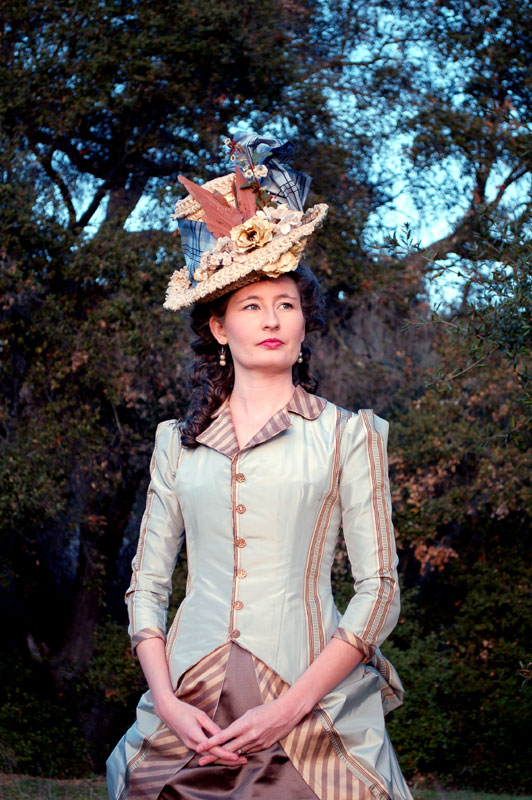
Finished Project: Jenn’s Wedding Reception Dress

I broke my usual code of not sewing for other people!

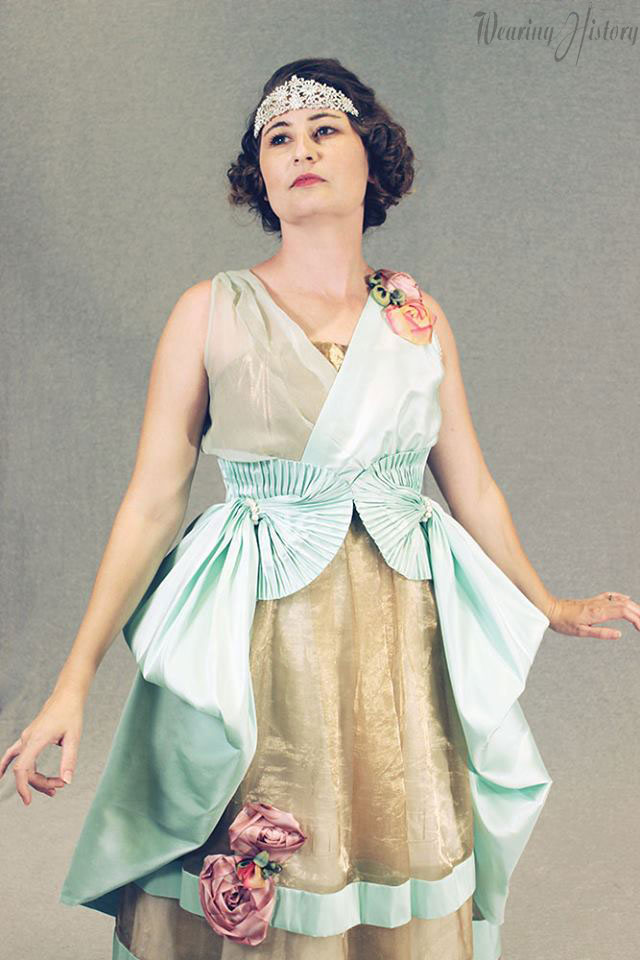
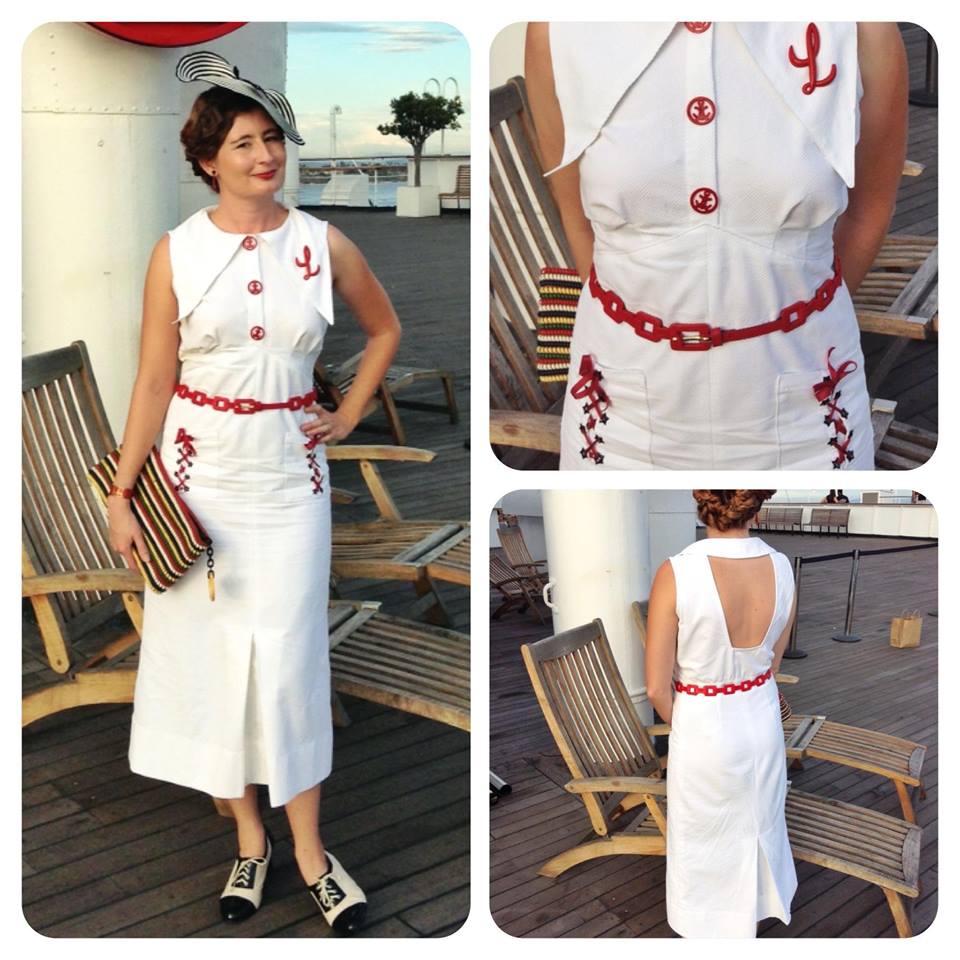
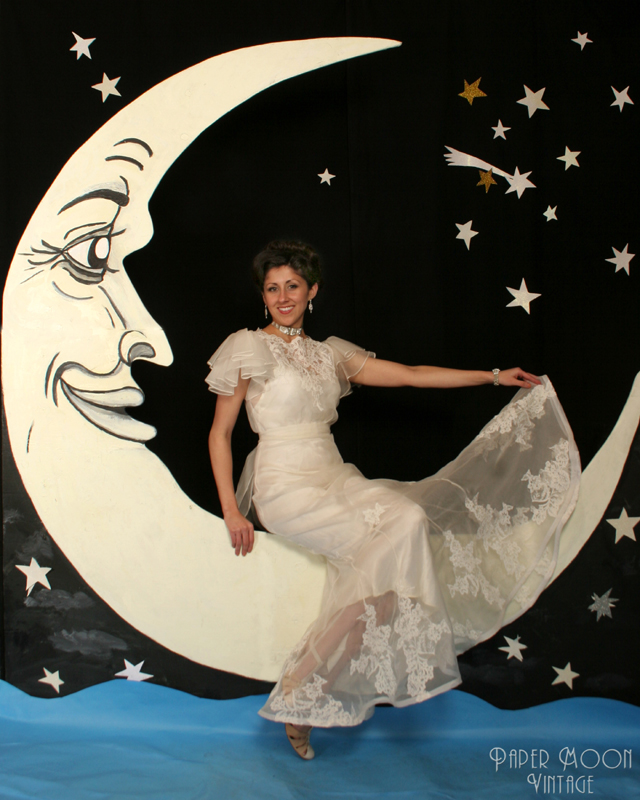
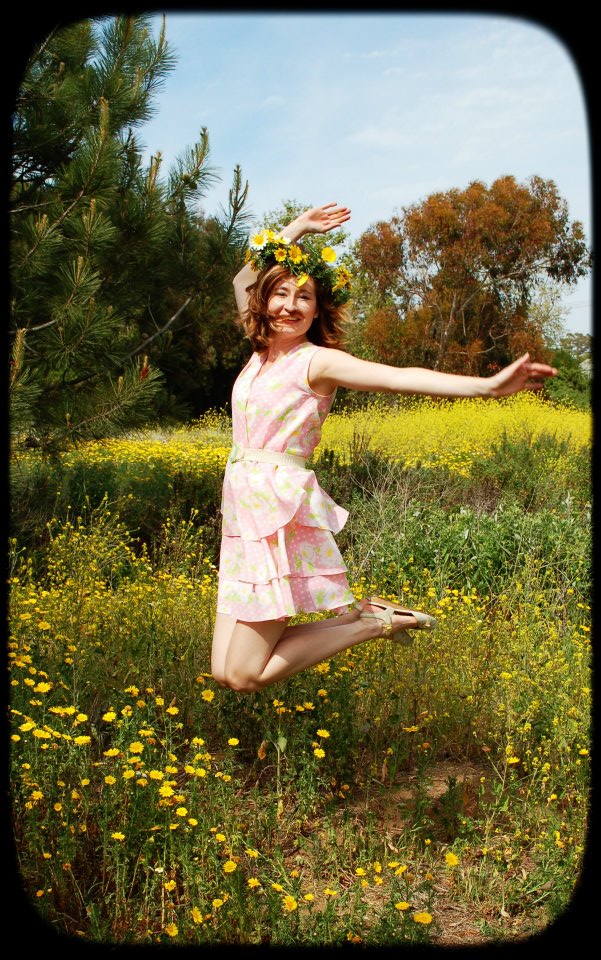
That’s right, I made another wedding dress.  I thought I’d be laid off for a month, and a lovely friend was getting married and could not find anyone to make her dress, so I volunteered.  Jenn wanted a 1930′s dance dress Ginger Rogers would be proud of.  We shared images, brainstormed, and finally came up with a design by cobbling together odds and ends of various vintage patterns to get together a dream dress for their 1930′s themed wedding on Catalina island in the glorious Art Deco ballroom.  Unfortunately I’m a big wuss and don’t like boat travel, so wasn’t able to attend.  Many thanks to Nicole of Paper Moon Vintage who took these photos and sent them to me of Jenn looking fabulous in her dress!  Jenn’s makeup was by the talented Katharina of GoForKat makeup.

Jenn’s reception dress was made of Italian imported silk organza and Italian imported Alencon lace.  We added horsehair to the hem to give it “swish” when dancing, and she’s wearing a vintage slip underneath.  Something old, something new.  The lace was appliqued on and cut away from behind on the bodice front and back to create a neat illusion of a lower front and back than the dress actually had.  The motifs were carried across onto the bottom of the skirt gores to tie it all in.

This dress just happened to be finished just in time to tie in with the schedule of the Sew Fortnightly “Embellish” project.  I know we’re supposed to say time, cost, etc for the Sew Fortnightly, but I don’t want to even think of how long it took.  Jenn’s mom bought the fabric for the dress, and I was paid for my estimated cost of time it would take to make the dress.  Part of the cost of the dress, since I grossly underestimated time, was a wedding and bridal shower gift for the happy newlyweds.  So it worked out for both of us.

Many congrats to Jenn and Benny! Yay!! Welcome to married bliss :)

Thus ends was my brief foray into custom dressmaking again.  Love my friends and “fans”, but I’ve got other eggs in my basket, so I’m passing the custom work so that those who are more talented at it, and love it more than I do.  I’m now retired from custom dressmaking… got enough between regular work and my patterns and life stuff to keep me busy!

Hope your week is much blessed!

Lauren

Finished Project: The Dust Bowl Dress

The project for the Historical Sew Fortnightly Challenge this time was “Peasants & Pioneers.”

From the event page on Facebook:

“As wonderful as making pretty, pretty princess dresses is, the vast majority of people have always been poor commoners, whether they were peasants working the land, servants in big houses, or (later), pioneers carving their own space in new lands. This fortnight let’s make something that celebrates the common man.”

This automatically made me think of the dust bowl and the great depression.  The incredible hard times that people of my grandparent and great grandparent’s generation had to endure.  I want to celebrate something in our more recent history, within the memory of many of those still alive today.  The great depression, of course, hit across our nation (and internationally as well), but the dust bowl hit only part of the country, causing incredible hard time among those in the path of the dust storms, and forcing many to “pioneer” out to places for a new start, like California, in order to pick crops or use their farming skills where the soil was still fertile.

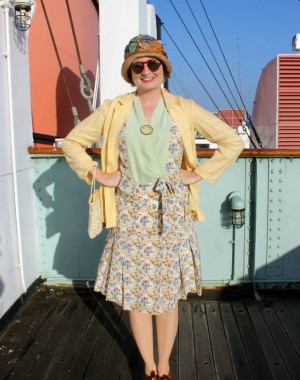
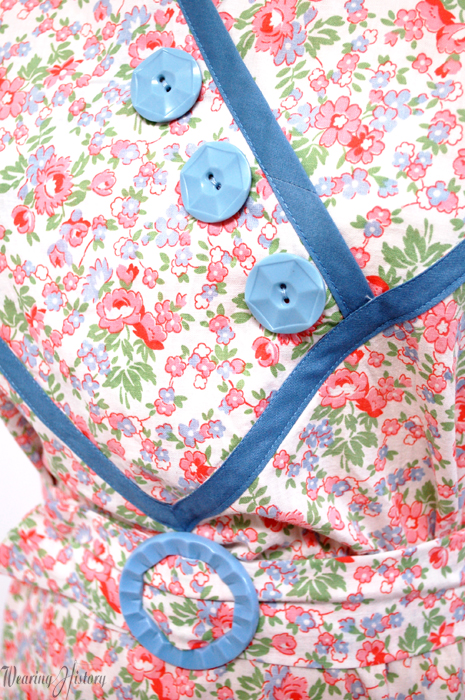
The dress I made is from all vintage materials.  I was fortunate to find a long length of vintage cotton print that I found reminiscent to the feed sack prints the ladies of the dust bowl would have used to make their clothing.  These were actually flour or feed sacks, and a housewife would collect them to make clothing for her family, or sew items for the home.  The buttons, buckle, and the bias tape are all vintage as well.  This is finished on the inside with rayon seam binding.

Very contrary to the dust bowl, today is a very cloudy and rainy day.  I was hoping to take pictures next to some old west style historic buildings, but it was not meant to be!  Since it’s a dark day, it is very hard to capture the colors correctly.

Without the belt, the dress looks rather 1920s.

A closer shot of the detail, which is more true to actual color:

This was made from a  mail order pattern from the earlier part of the 1930s, similar to what farming ladies would have used to make their clothing.  I have a copy, as I sent my original to a friend in England.  Although the dress in the illustration looks rather sporty, I wanted to take inspiration from vintage farm dresses and aprons, so added the bias tape to make this look more like a house dress.

Some inspiration images for this project that were found online:

{Source}

{Source}

{Source}

{Source}

Required info for this challenge

The Challenge: Peasants & Pioneers

Fabric: Vintage cotton print

Pattern: Mail Order 1918

Year: First half of the 1930s (about circa 1932-1934)

Notions: Vintage bias tape, vintage buttons, vintage buckle

How historically accurate is it? Very.  Without finished seams it would be more period, but I wanted to protect from fraying when washing.  The thread is poly, which is not period, but otherwise it’s totally dead on.  I found prints almost identical in a 1934 Sears catalog.

Hours to complete: Around 5-6.

First worn: Not yet!

Total cost: About $25 (not including pattern)

Finished Project: Blue Corset from 1868

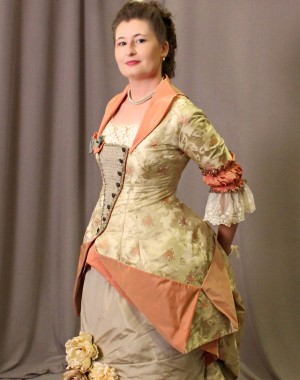
I just put the finishing touches on this today, and I’m so glad to finally have it done!  I started the mock up for this sometime last year.  I really wanted a corset I could wear to get a decent silhouette for late 1860s/early 1870s gowns.  I have one Victorian corset I made myself, but it’s more appropriate for the 1880s and didn’t give me much form.  I started reading up about how women who weren’t endowed got their shapes, and talked to other costumers about it.  Jen of Festive Attyre was especially helpful in figuring out what to do.  This corset has sort of revolutionized my thinking about making them, and I’m glad to say that I’m no longer paranoid about making corsets.  It was revolutionary to me to realize that I could make myself fit a corset shape, and fit a corset to fit *me*, when my shape is so not what was the period ideal for the Victorian era.

When I started thinking about this project I knew I wanted a blue corset, like in Edouard Manet’s painting Nana, from 1877.  Although later than this corset by nearly ten years, I have always loved this painting and knew I wanted to mirror this color scheme when I made mine.

The pattern for this corset came from Francis Grimble’s Reconstruction Era Fashions book.  It was reproduced from an original Harper’s Bazar pattern from 1868 and then scaled down by half.  I re-enlarged the pattern and did my mock up. I found in the mock up stage that the original sizing of the corset pattern was several  inches too big for me, so I did some adjustments at the side seams, and some smaller adjustments to the hip and bust gussets, but made sure to leave enough room and not over fit it, so that I had room to pad out to achieve close to a period shape.

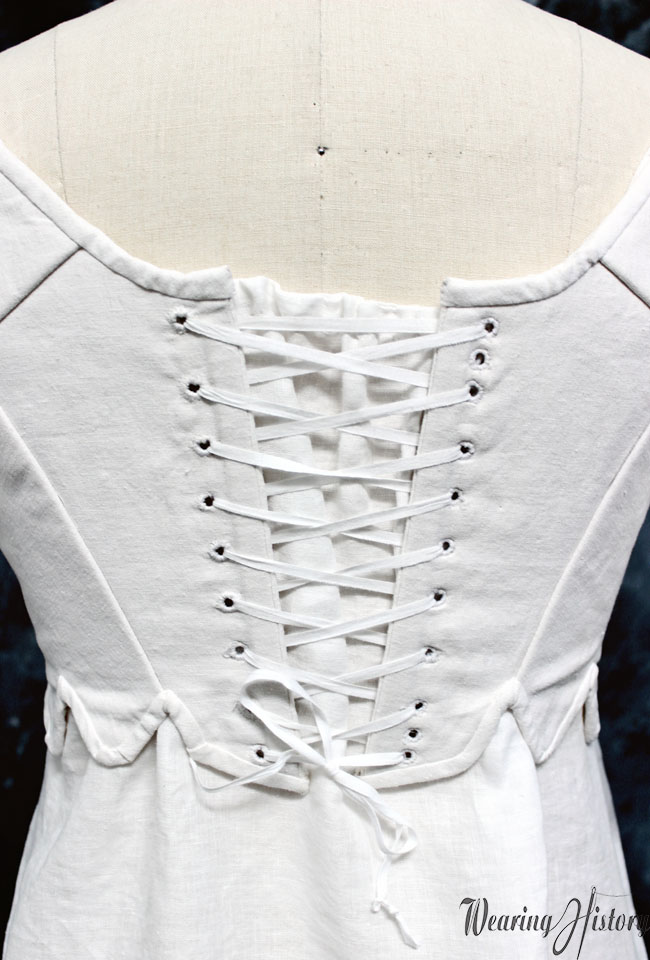
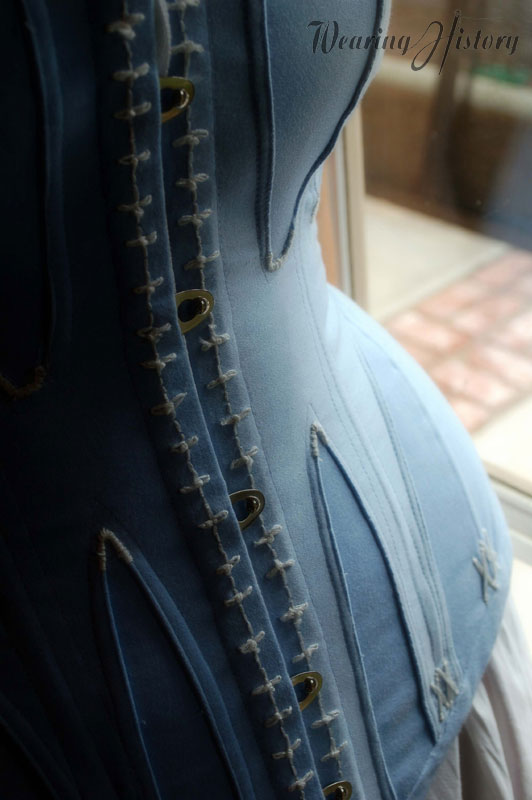
The original pattern called for boning across the back, but I decided I would rather have cording as I thought it would be both more comfortable and more decorative.  My husband was a darling and did the grommets up the back for me.  That’s one thing I really don’t like to do!  The chemise I am wearing is an antique in my collection.  Although I wouldn’t really wear it under clothing for fear of damaging it (although it is quite sturdy), it was fun to wear for pictures.  I need to make one along similar lines someday.

I should also mention that when I went to do my boning channels I realized I missed a tuck that was called for that went from the bottom of the front bust gusset to the bottom of the corset.  Oops?  Since I had already done all my fittings without this tuck I just decided to leave it be, but that accounts for one of the bust gores having a squared off shape at the bottom rather than a point.  Doesn’t bother me, but in case others wanted to try this pattern I thought it should be mentioned.  And as with all period patterns of this age, no seam allowances were included in the original pattern.

The fabric I used was white cotton coutil, to which I flat lined blue cotton sateen.  I was sick for quite a few days last week, so I used the opportunity to do something I don’t usually do- and embroider a little motif up the front of the busk and add some flossing.  I don’t have much skill at this sort of handwork, but it was fun to do and I think it looks kind of pretty!  My initial thought was to do flossing and add a contrast binding and wide lace at the top, but I really like the simplicity of these accents and I’m glad I didn’t go with my first plan.

Just like today, women would pad out what nature didn’t give them naturally.  As I mentioned previously, I was on a quest to get a bit more of a Victorian shape than I had naturally or with my previous corset.  When I took my mock up of this corset to work with me, I had some help from a theatre perspective and found that they still use this trick. One of the “tricks of the trade” are to use men’s tailoring shoulder pads and place them strategically at the sides, both at top of the corset, and at the bottom, to create more of an hourglass shape.  Then you can use little pads in the front for extra support- to create a bit of a shelf.  I tried this, and lo and behold, I actually had a decent shape for the era! Much better than I had had previously.

Since this project was done in conjunction with the Dreamstress’ great group, The Historical Sew Fortnightly, here’s the info required.

The Challenge: Under it All

Fabric: Cotton coutil, cotton sateen

Pattern: Reproduced Harper’s Bazar pattern from Frances Grimble’s Reconstruction Era Fashions Book.

Year: 1868

Notions: Metal spiral and flat steel boning, corset busk, grommets, corset lacing, cotton embroidery floss, stay tape, thread, set of pre-made shoulder pads, cotton quilt batting to make two more pads, white muslin to cover shoulder pads.

How historically accurate is it?  Looks accurate on the outside (embroidery inspired by, rather than reproduced authentically from, period examples), but the inside and construction are done with modern methods.  The gussets were flat lined then serged, and applied with  lapped seams rather than flat felling.

Hours to complete: Several.  From start to finish, perhaps around 10 hours, including several mock ups and time to enlarge and alter the pattern.

First worn:  Not worn yet other than for photos

Total cost: Didn’t keep track but I’m guessing $35-40ish, not including the book cost.

Finished UFO Project, and a Peek at Things to Come…

Did you know that The Dreamstress is hosting a neat Facebook sewing motivation group for this year?  It’s called the Historical Sew Fortnightly, and every two weeks there’s a new challenge.

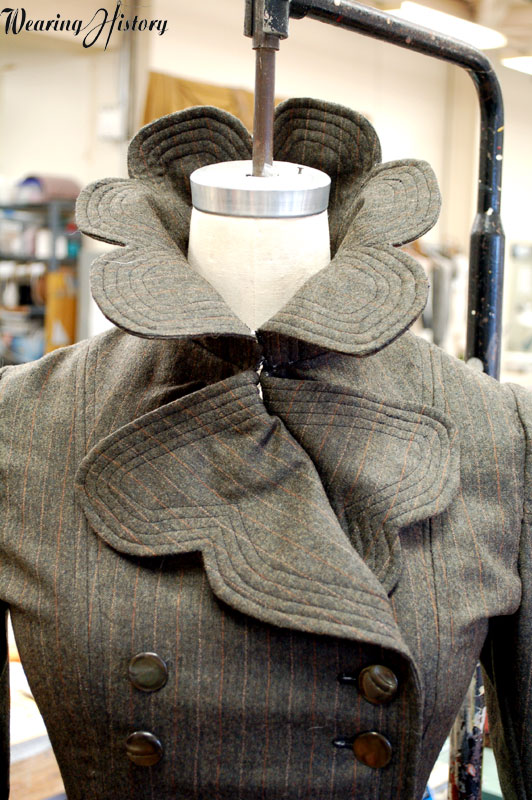
I missed the last challenge, but I got this one finished in time for the UFO theme (unfinished object).  This jacket was based on an 1899 jacket pattern from La Mode Illustree, and I don’t mind saying now, that this is the pattern that I’ve slowly been working on in my free time as the next Wearing History pattern release.  The project was started a year or two ago, with an original pattern, but gradually morphed into a grande project, as I kept finding more and more that I needed to do to make the pattern more accessible and understandable (markings, seam allowances, grainlines, and instructions were all missing, and the pattern pieces needed alterations to get them to fit together correctly).  I’ll have more info on it once it’s completely finished and I have the pattern up on my site, but for now I’m just glad to share preview pics I took at work today :) I went all out on this jacket and did a bunch of tailoring on it to make it extra nice.


Finished Project: A 1940s Patriotic Sweater and an Update

First of all, I want to thank you all who took the time to comment on my last blog post about our car accident and my new job.  All of your kind thoughts and prayers have been truly appreciated.  I’m still not normal yet (it happened only a week ago), but things are getting better little by little.

It ends up I had a concussion and several pulled muscles, as well as whiplash.  My husband is not quite as bad (the car hit mostly on my side), but he does have injuries as well, including whiplash and sore muscles.  For what happened, we’re SO fortunate it wasn’t worse!!  I’ve got some meds from the doctor and have started physical therapy, which is helping, and I’ve been using an ice pack quite a bit which helps the soreness and headaches.  I can’t really do much sewing, since it really hurts my shoulder. In a way I’m thankful it happened when it did, since I have a few weeks off for the holidays- there’s no way I feel good enough yet to get back to work.  Of course, we wish it didn’t happen at all.  It did end up my cousin’s truck, which we had borrowed for the weekend, was totaled, as well as the girls car.  Just horrible.  :(

Between my twice a week allergy shots (spending about two hours a week in the doctor’s waiting room) and spending weekends at home (before the accident) I had nearly finished this sweater a few weeks ago.  So, little by little, I have been doing a little finishing on it.  I’m so excited- I am such an A.D.D. knitter- I start things, get sidetracked, rip them out, start something else.  I actually started AND finished a project!  Hurrah!

I still think of myself as a beginning knitter, even though I’ve been doing it on and off for several years, and even I was able to work up this pattern with little difficulty.  It’s been for sale as a download on my website for probably a year or so, but now I have sample pictures to go with it and a sweater for myself!  Yay!


I got the yarn (Vanna’s Choice) on super sale at Joann’s on Black Friday this year.  Since I wasn’t sure if I actually would be able to finish it or knit it up, I wanted to try with cheaper yarn.  In the end I like it *ok* but wish I had chosen something with natural content instead of 100% acrylic.  Ah well, for the next project I will!

The buttons are vintage and bought from Atomic Regeneration on Etsy.

And you can get the knitting pattern on my Wearing History Patterns website.

Hope you have a great weekend, and if I don’t check in again, a very blessed Christmastime!

God Bless,

Lauren

Finished Project: Autumn Floral Smooth Sailing Blouse

I haven’t shared a project in such a long time!  I have had this finished for several months and already worn it a few times, but my husband snapped these photos on Thanksgiving so I could finally share the project with you!

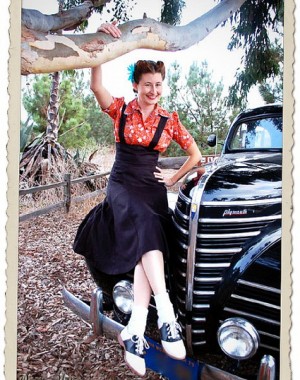
My thanksgiving outfit was my new blouse from my Smooth Sailing pattern, paired with a jumper made from a vintage pattern several years ago, a me-made hair flower, Payless saddle shoes and white socks.  I’m so excited that my hair is finally long enough to style without having to do a wet set for curls!  My hair refuses to hold a hot set now that my perm has grown out.

Whenever I wear a dress or skirt with a lot of “swish”, I can’t help playing with it!  I’m like a little girl playing dress up.

I saw this fabric at Joann fabrics and instantly fell in love! I knew it had to be a Smooth Sailing blouse. I’ve worn the other two I’ve made so much that they’re starting to look a little ragged. The fabric is SO cute, and so appropriate for vintage! It’s a “premium quilting cotton” be DS Quilts Collection called “Richmond Floral Red”, but mine is really more of a dark pumpkin color with a little red tone.  I bought mine in the store, but it’s still available online here at Joann fabrics.

I paired the fabric with a blue piping for accent and little baby rick rack on the pockets.  I had stashed some great vintage plastic floral buttons for quite a number of years and had them up on my bulletin board- knowing that sooner or later the perfect fabric compliment would come along.  Well, it finally did, and now they have a home on my new blouse.


Just for kicks, gotta add this silly shot.  I can haz no skillz of a pin up. LOL!

Hope you had a lovely holiday!

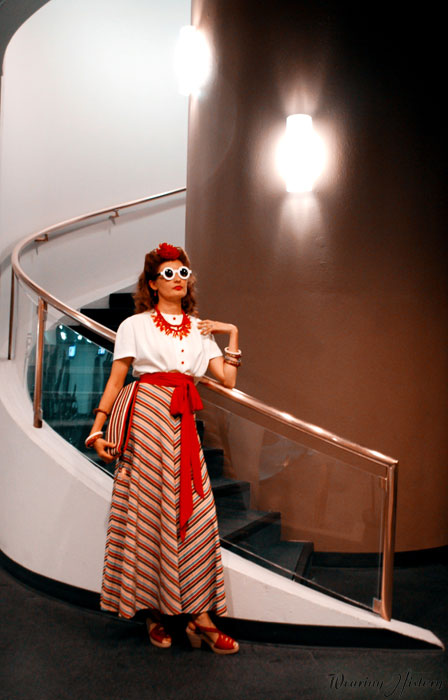
The 1939/1940 Vogue Outfit

I want to take some more photos of this at a later time, but I wanted to share this outfit I wore (very briefly) at Costume College on Sunday.

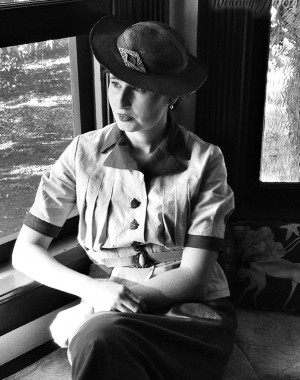
I made the blouse for this ensemble because I saw a similar outfit in a 1939 issue of Vogue magazine that I wanted to imitate.  It was made using a vintage McCall blouse pattern from 1940.  The red scarf belt was made of silk which I had made for a prior outfit, but it worked out perfectly.  The shoes are ones I purchased several years ago by FarylRobin (the style is called Canary).  The glasses were recently purchased from ASOS and are very reminiscent of the ones on the July 1939 cover of Vogue magazine.  The skirt is vintage and was bought from Top Tottie Vintage.  The purse was a recent garage sale find.  The necklace and earring set is new and was bought on Ebay.

I hope to get more photos of this blouse soon, but my friend Ginger of Scene in the Past blog took this shot and the staircase was perfect for the late 30s streamlined look so I had to share :)

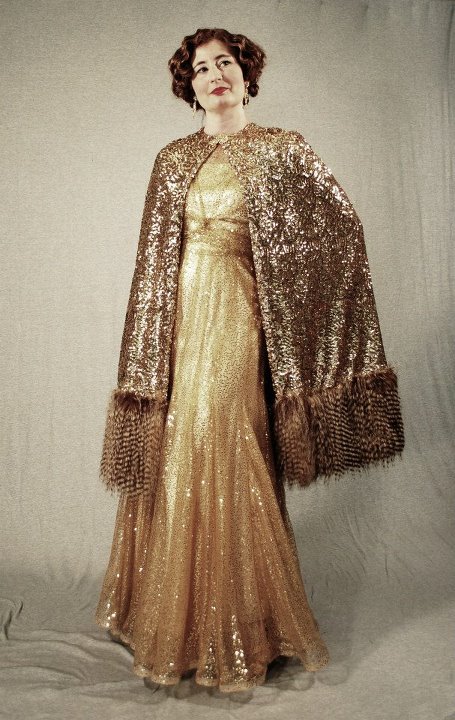
Finished Project: The 1930s Gold Classic Film Dress

Wow- Another project to post! I must be on a roll.  I have two more to post, but both of which I didn’t get *terrific* photos of, or no photos of, so this may be the last for a while.  Or maybe I’ll just borrow photos from friends.

The theme of Costume College this year was “The Golden Age of Hollywood.”  If you remember, last year I made a gold satin 1930s dress with a cape.  Well, that was before the theme for this year was announced.  Obviously I had to repeat the vintage theme… and the gold… and a cape… ;)

In all reality, this project didn’t completely come together until a few weeks before Costume College.  I was being indecisive.  Couldn’t decide on pattern… couldn’t decide on a fabric.   I just knew I wanted it to be sparkly.  Bought a fabric that didn’t work out.  You know why?  I thought “surely, 4 yards will be enough for a 1930s evening dress.”  But then I remembered a skirt I drafted based on dresses worn by Ginger Rogers in the Fred + Ginger movies and pulled it out and laid it down on the fabric.  In the end the dress took over 10 yards.  The previously bought fabric is marinating in the stash until it becomes something else (and right now I’m thinking that something else will be a 1920′s evening dress.  I blame Katherine/Koshka of The Fashionable Past).

One of my all time favorite 1930s evening dresses was one worn by Harriet Hillard as Connie Martin in Follow the Fleet (a Fred and Ginger movie).  Although I really don’t like the musical number, here’s a video clip from YouTube showing the dress in motion.  I think I was subconsciously thinking of this dress when I made this one!  In the end it looks rather similar.  In fact, I’m now determined to make myself a pretty spray of gardenias to wear across the front next time I wear the dress:

But enough chatting!  On to pictures!

What’s a dress without a cape, right? The cape was made from a 1940 McCall pattern of “scale” sequin fabric with a faux fur trim at the hem.  The dress itself was made from a strange almost netted fabric with gold spangles all over it.  The slip was made from gold lamé crepe bought from SewHallie (aka Couture Allure) on Etsy.  I was trying to harken back to the fabulous gowns of Hollywood yesteryear with this dress.

The dress itself was a combination of many patterns.  I drafted the skirt based on Ginger Rogers’ dresses (as mentioned earlier) and the top of the dress was cobbled together from three different vintage patterns.  Luckily it fit perfect after the first mockup.  The hem has horsehair in the edge to help give it extra body and “swirl power”.  I added fishing line to the edge of the sleeve to help it have a little more body at the hem as well.

The best part about the dress is the swirl power!

So that’s it! This was my secret Costume College Gala project.  It’s very fun to dance in, so I hope I get to trot it out again soon :)

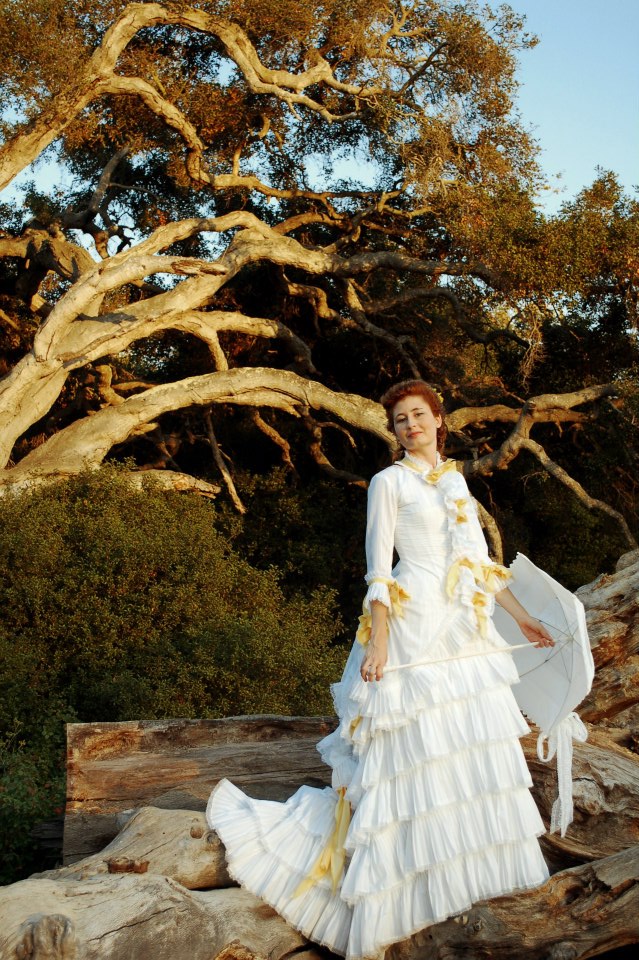
Finished Project: The Tissot Dress

Fair warning- this is a long and picture heavy post!

This dress had been a long time on my wish list.  I’m an ardent fan of James Jacques Tissot’s paintings, and a particular dress that appeared in a few variations in several of his paintings really inspired me.  The dress is not an exact copy, but is inspired by the following paintings.

This was the first one I found, called The Gallery of H.M.S. ‘Calcutta’ (Portsmouth), 1877.  This image is from the Hermitage Collection Connection’s blog.  My good friend is eventually going to make the one in blue so we can go about together in our ensembles :)

 Then I found several more paintings in which this image appears:

Portrait of Miss Lloyd (on left) from loveisspeed.  July (on Right) posted by a friend online.

July: Specimen of a Portrait from Flickr (on left), Fete Day at Brighton from Wikimedia Commons (on right) has different color bows but is the same dress.

  I started this dress in June of last year and actually did wear it to Costume College last year, but only for an hour or two, during which I taught a class.  After Costume College last year I finished it up and meant to take pictures the entire year, but after a bit of thought decided I liked it too much to not wear again, so it made another (longer) appearance this year.  The photos below combination of photos taken at Costume College this year and afterward at a public park.

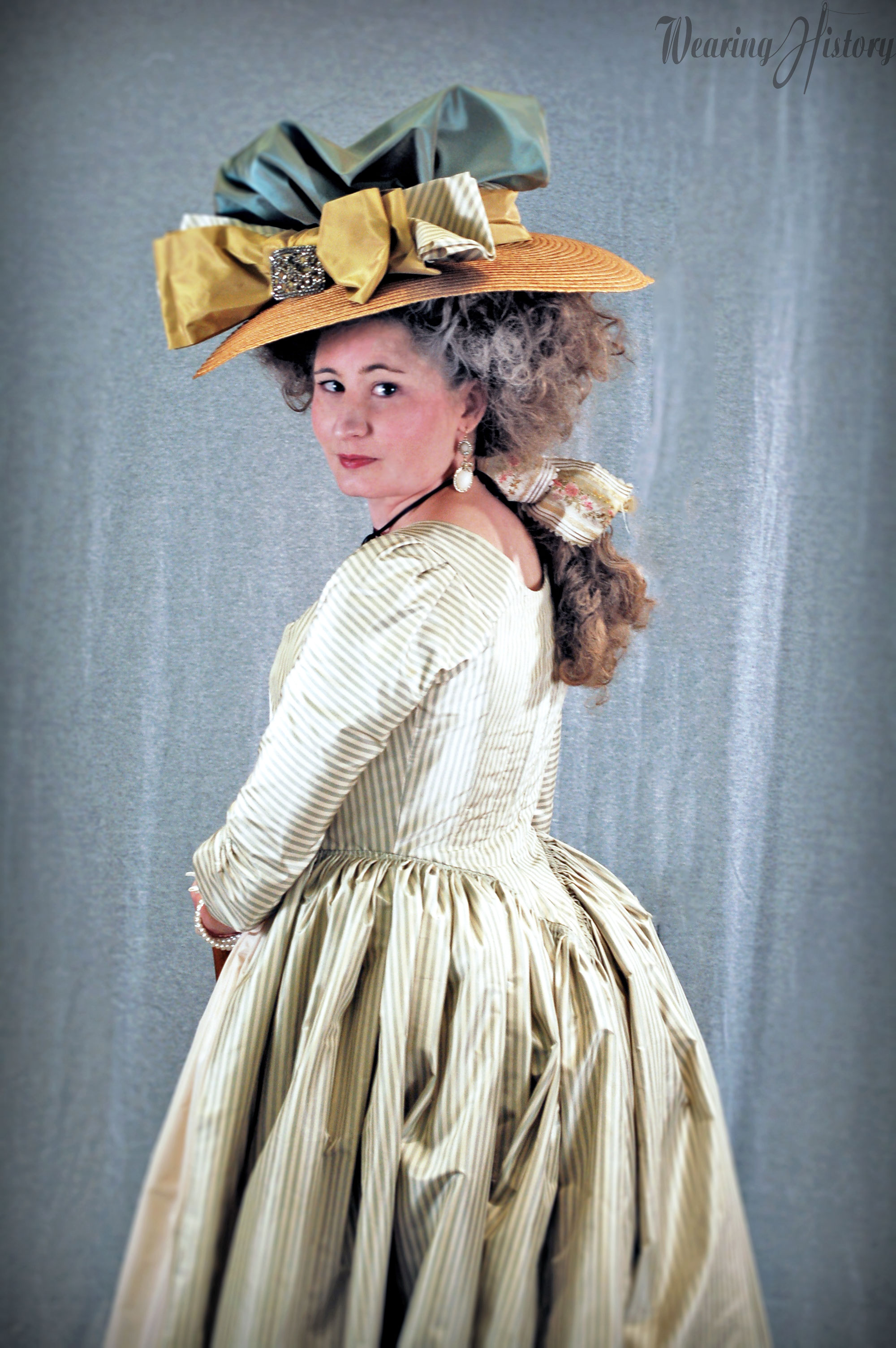
The skirt was made from the Truly Victorian natural form Fantail Skirt pattern.  I wanted this to be a transitional dress between early bustle and natural form, so I actually tied the back of the skirt looser (it’s on a drawstring) and fit it over my Truly Victorian Petticoat with Wire Bustle, and tied the tapes inside the bustle somewhat loosely to have a smaller bustle shape.  The “polonaise” was made using the basis of Truly Victorian bodice shapes and I compared the cut with several in Francis Grimble’s Fashions of a Gilded Age (I don’t remember if it was book 1 or 2).  Since I am already familiar with the cut of Truly Victorian bodices I found this to be easier than scaling up and fitting a bodice from an original pattern I wasn’t familiar with.

The skirt and polonaise are both accented by pleating that is edged in lace.  The front fastens up the center front with hook and eye tape, and the bows are taffeta cut into bias strips and then tacked on.  The dress is made from a cotton/poly blend.  I was told it was all cotton when I purchased it in the Garment District in LA, but boy- was pleating it a pain!  I used the Perfect Pleater, but since it had poly in it, it did not want to hold the pleats.  In the end I used a combination of vinegar/water to set the pleats- sprayed it heavily and ironed the pleats in until they were well dry.  I waited for it to cool.  I then did a heavy coating of spray starch, gave it a second to set, then ironed it well (too soon after spraying and it would stick!), and then waited for that to cool.  Part way though this project I realized how beneficial a press cloth can be!

Yes, it took FOREVER and is not something I’d like to repeat soon.  I’m actually unsure of the yardage. I just kept going until I ran out of fabric! I’d still like to make the matching jacket but I ran out of fabric.  I just saw it again on the last trip to LA, but forgot why I wanted it.  Of course, now I remember! I hope they still have it whenever I go back- I went on a wild goose chase last year trying to find the darn fabric again with no luck!

At the last minute before Saturday at Costume College I remembered I didn’t have a hat so threw one together very quickly with fabric scraps and hot glue on a straw base bought from Truly Victorian when they sold these.  My husband painted it white for me last summer.

I just posted my favorites here (and I know there’s a lot) but I have several more photos of this dress on Flickr which aren’t in this post.  You can see them here.

This dress feels like a dream to wear. I just adore white dresses from the Victorian and Edwardian eras!  I need more excuses to pull this one out in the future

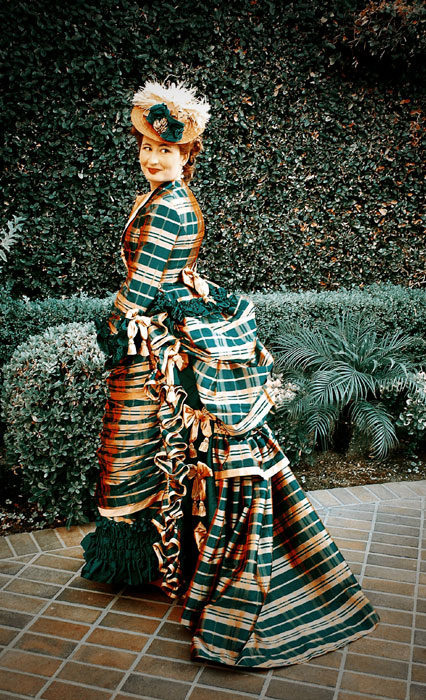
Finished Project: The 1870s Green Plaid Bustle Dress

I’m back from Costume College, my good friend is on her way back home to Texas, and it’s time to get back to real life. Woe!  But I have some fun photos to share coming up, and the first of which I want to share is the 1870s plaid bustle dress project I posted about previously.

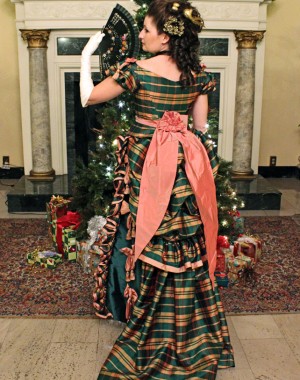
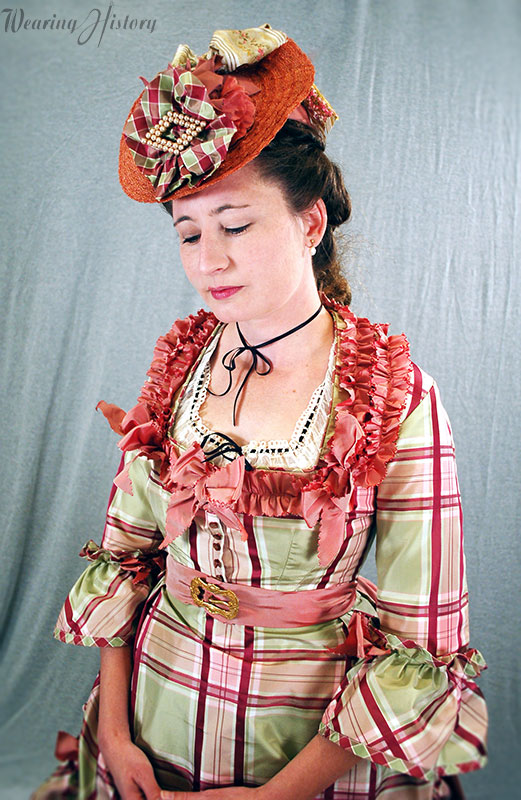
I finished it all up for the most part by the time my friend arrived, but since she had some extra sewing to do I started doing trimming.  And more trimming.  And more trimming.  Someone on the American Duchess Facebook album of Costume College photos said it looked similar to old fashioned ribbon candy- and you know, I have to agree!

This one was lots of fun to trim.  I love this time period.  I can trim, and trim the trims, then trim the trim with trims.  In this case the most fun things to make for trimming were the ruffles which were finished with a bias binding in the peach. Over the top of the ruffles at the side I ran a braid which was made of three tubes of bias made into cording and then braided.  The bows that are accented with tassels at the end were lots of fun to make, too.

This outfit was made using Truly Victorian patterns.  The bodice was made with Heather’s new 1872 Vested Bodice Pattern, TV403.  The skirt was made with the 1875 Parisian Trained Skirt Pattern, TV216 (you can see my previous version of the skirt in their website photo).  I’m a huge fan of Truly Victorian patterns- they make these Victorian patterns so accessible, and they make up really well!  I documented working on this bodice in prior posts here, here, and here.

Capturing the correct colors of this outfit has proved quite difficult.  In reality it’s probably a combination of the photos here in front of a blank background and the photos above.

The hat is actually a 1930s hat I had in my vintage collection.  At the last minute I remembered I didn’t have appropriate headwear so I pulled out this one, which just so happened to match perfectly.  I pinned little accents of the green onto the hat, added a pink feather and a few dress clips, and it suddenly became passable for 1870s.  The entire dress was made from polyester taffeta (gasp!) but the fabrics looked so much like authentic silk taffeta, even in person, and had the same hand to the touch, that I was able to make the dress look passable on a much better budget than by using a more authentic silk.  For a dress I’ll only wear on occasion, I decided it was a good sacrifice for me to make and it helped out my pocketbook ;)

That wraps up this project!  The End ;)