Finished Project- The “You Were Never Lovelier” Fringey Dress

Thanks to my good friend, Beth, I have pictures to share of this project!

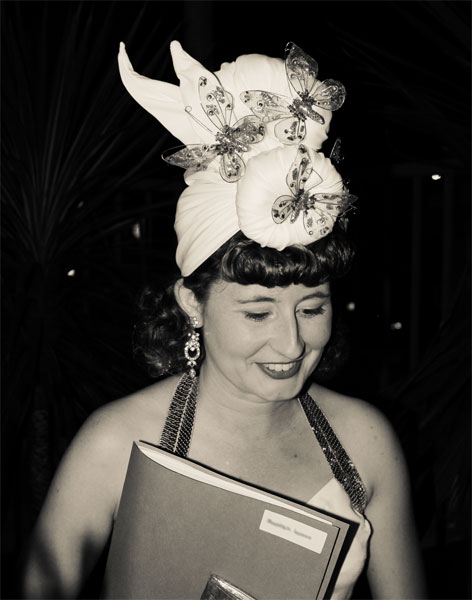
This was another dress I made for Costume College this year.  The theme of the evening on Thursday night was “Carmen Miranda,” but when I was watching You Were Never Lovelier a month or so before Costume College I knew I needed the fringey dress that his lead singer of Xavier Cugat’s band wore in one of the opening numbers.  It just so happens to be on YouTube, so here it is (and now the song will be stuck in my head all day).

The dress and strap were made of fabrics in the stash.  The fringe was bought on Etsy.  I had an interesting time coming up with the pattern- it actually started life as two seperate patterns (one mid 1930s, one mid 1940), which were combined, draped, and completely altered to make it work to be similar to this design.

Here’s Beth and I at the party.

And, of course, since it was Carmen Miranda themed, I needed to add a turban!  Stephanie posted a great image of Carmen Miranda with a butterfly turban, so I knew I needed one!  It was made by draping swimwear fabric on a foam head block, then creating rings of quilt batting and covering them with the same fabric.  The pointy bits were sewn to that shape then I added millinery wire to make them stand up. The glittery butterflies came from Ebay.

That wraps up all the projects I made for this year’s Costume College :)  Many thanks again to Beth for the pictures!

The 1939/1940 Vogue Outfit

I want to take some more photos of this at a later time, but I wanted to share this outfit I wore (very briefly) at Costume College on Sunday.

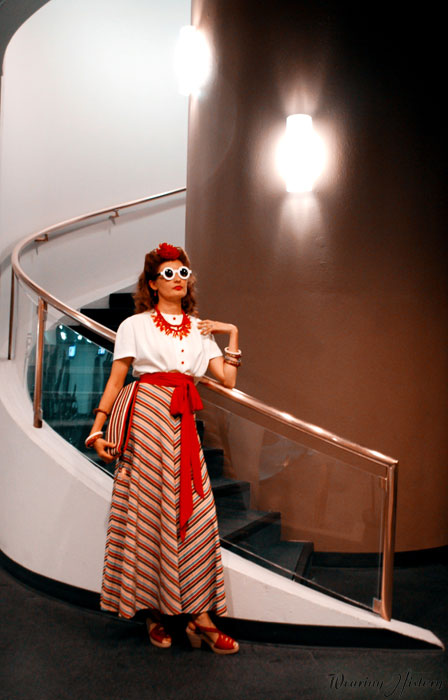
I made the blouse for this ensemble because I saw a similar outfit in a 1939 issue of Vogue magazine that I wanted to imitate.  It was made using a vintage McCall blouse pattern from 1940.  The red scarf belt was made of silk which I had made for a prior outfit, but it worked out perfectly.  The shoes are ones I purchased several years ago by FarylRobin (the style is called Canary).  The glasses were recently purchased from ASOS and are very reminiscent of the ones on the July 1939 cover of Vogue magazine.  The skirt is vintage and was bought from Top Tottie Vintage.  The purse was a recent garage sale find.  The necklace and earring set is new and was bought on Ebay.

I hope to get more photos of this blouse soon, but my friend Ginger of Scene in the Past blog took this shot and the staircase was perfect for the late 30s streamlined look so I had to share :)

Finished Project: The 1930s Gold Classic Film Dress

Wow- Another project to post! I must be on a roll.  I have two more to post, but both of which I didn’t get *terrific* photos of, or no photos of, so this may be the last for a while.  Or maybe I’ll just borrow photos from friends.

The theme of Costume College this year was “The Golden Age of Hollywood.”  If you remember, last year I made a gold satin 1930s dress with a cape.  Well, that was before the theme for this year was announced.  Obviously I had to repeat the vintage theme… and the gold… and a cape… ;)

In all reality, this project didn’t completely come together until a few weeks before Costume College.  I was being indecisive.  Couldn’t decide on pattern… couldn’t decide on a fabric.   I just knew I wanted it to be sparkly.  Bought a fabric that didn’t work out.  You know why?  I thought “surely, 4 yards will be enough for a 1930s evening dress.”  But then I remembered a skirt I drafted based on dresses worn by Ginger Rogers in the Fred + Ginger movies and pulled it out and laid it down on the fabric.  In the end the dress took over 10 yards.  The previously bought fabric is marinating in the stash until it becomes something else (and right now I’m thinking that something else will be a 1920′s evening dress.  I blame Katherine/Koshka of The Fashionable Past).

One of my all time favorite 1930s evening dresses was one worn by Harriet Hillard as Connie Martin in Follow the Fleet (a Fred and Ginger movie).  Although I really don’t like the musical number, here’s a video clip from YouTube showing the dress in motion.  I think I was subconsciously thinking of this dress when I made this one!  In the end it looks rather similar.  In fact, I’m now determined to make myself a pretty spray of gardenias to wear across the front next time I wear the dress:

But enough chatting!  On to pictures!

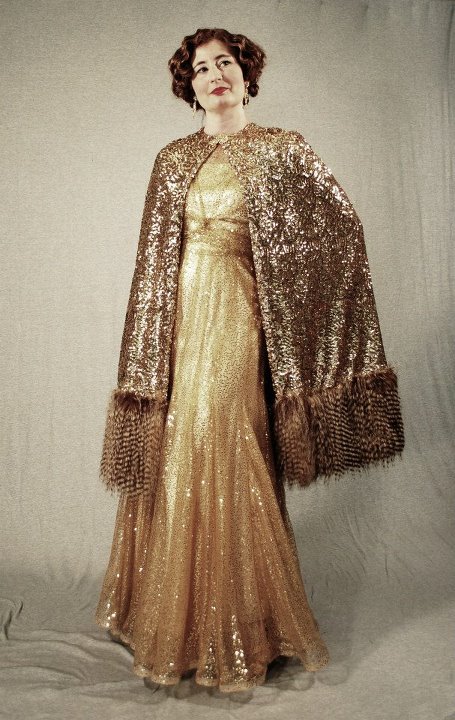
What’s a dress without a cape, right? The cape was made from a 1940 McCall pattern of “scale” sequin fabric with a faux fur trim at the hem.  The dress itself was made from a strange almost netted fabric with gold spangles all over it.  The slip was made from gold lamé crepe bought from SewHallie (aka Couture Allure) on Etsy.  I was trying to harken back to the fabulous gowns of Hollywood yesteryear with this dress.

The dress itself was a combination of many patterns.  I drafted the skirt based on Ginger Rogers’ dresses (as mentioned earlier) and the top of the dress was cobbled together from three different vintage patterns.  Luckily it fit perfect after the first mockup.  The hem has horsehair in the edge to help give it extra body and “swirl power”.  I added fishing line to the edge of the sleeve to help it have a little more body at the hem as well.

The best part about the dress is the swirl power!

So that’s it! This was my secret Costume College Gala project.  It’s very fun to dance in, so I hope I get to trot it out again soon :)

Finished Project: The Tissot Dress

Fair warning- this is a long and picture heavy post!

This dress had been a long time on my wish list.  I’m an ardent fan of James Jacques Tissot’s paintings, and a particular dress that appeared in a few variations in several of his paintings really inspired me.  The dress is not an exact copy, but is inspired by the following paintings.

This was the first one I found, called The Gallery of H.M.S. ‘Calcutta’ (Portsmouth), 1877.  This image is from the Hermitage Collection Connection’s blog.  My good friend is eventually going to make the one in blue so we can go about together in our ensembles :)

 Then I found several more paintings in which this image appears:

Portrait of Miss Lloyd (on left) from loveisspeed.  July (on Right) posted by a friend online.

July: Specimen of a Portrait from Flickr (on left), Fete Day at Brighton from Wikimedia Commons (on right) has different color bows but is the same dress.

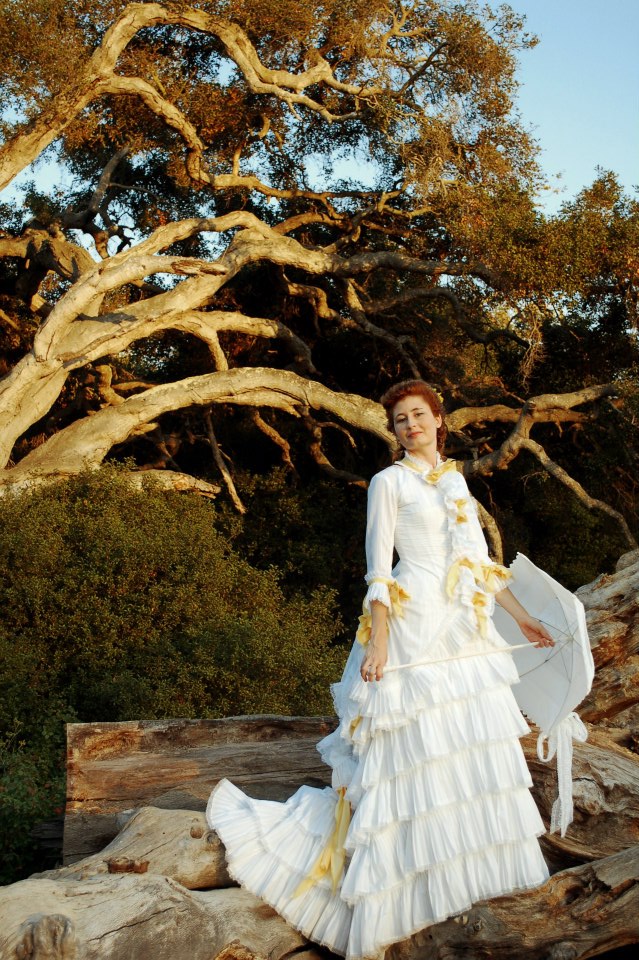
  I started this dress in June of last year and actually did wear it to Costume College last year, but only for an hour or two, during which I taught a class.  After Costume College last year I finished it up and meant to take pictures the entire year, but after a bit of thought decided I liked it too much to not wear again, so it made another (longer) appearance this year.  The photos below combination of photos taken at Costume College this year and afterward at a public park.

The skirt was made from the Truly Victorian natural form Fantail Skirt pattern.  I wanted this to be a transitional dress between early bustle and natural form, so I actually tied the back of the skirt looser (it’s on a drawstring) and fit it over my Truly Victorian Petticoat with Wire Bustle, and tied the tapes inside the bustle somewhat loosely to have a smaller bustle shape.  The “polonaise” was made using the basis of Truly Victorian bodice shapes and I compared the cut with several in Francis Grimble’s Fashions of a Gilded Age (I don’t remember if it was book 1 or 2).  Since I am already familiar with the cut of Truly Victorian bodices I found this to be easier than scaling up and fitting a bodice from an original pattern I wasn’t familiar with.

The skirt and polonaise are both accented by pleating that is edged in lace.  The front fastens up the center front with hook and eye tape, and the bows are taffeta cut into bias strips and then tacked on.  The dress is made from a cotton/poly blend.  I was told it was all cotton when I purchased it in the Garment District in LA, but boy- was pleating it a pain!  I used the Perfect Pleater, but since it had poly in it, it did not want to hold the pleats.  In the end I used a combination of vinegar/water to set the pleats- sprayed it heavily and ironed the pleats in until they were well dry.  I waited for it to cool.  I then did a heavy coating of spray starch, gave it a second to set, then ironed it well (too soon after spraying and it would stick!), and then waited for that to cool.  Part way though this project I realized how beneficial a press cloth can be!

Yes, it took FOREVER and is not something I’d like to repeat soon.  I’m actually unsure of the yardage. I just kept going until I ran out of fabric! I’d still like to make the matching jacket but I ran out of fabric.  I just saw it again on the last trip to LA, but forgot why I wanted it.  Of course, now I remember! I hope they still have it whenever I go back- I went on a wild goose chase last year trying to find the darn fabric again with no luck!

At the last minute before Saturday at Costume College I remembered I didn’t have a hat so threw one together very quickly with fabric scraps and hot glue on a straw base bought from Truly Victorian when they sold these.  My husband painted it white for me last summer.

I just posted my favorites here (and I know there’s a lot) but I have several more photos of this dress on Flickr which aren’t in this post.  You can see them here.

This dress feels like a dream to wear. I just adore white dresses from the Victorian and Edwardian eras!  I need more excuses to pull this one out in the future

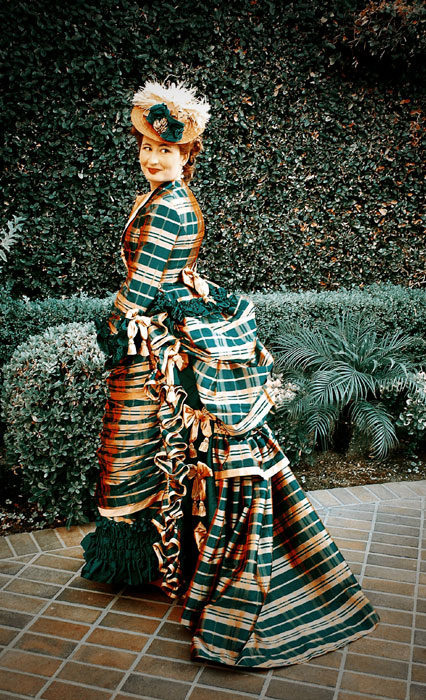
Finished Project: The 1870s Green Plaid Bustle Dress

I’m back from Costume College, my good friend is on her way back home to Texas, and it’s time to get back to real life. Woe!  But I have some fun photos to share coming up, and the first of which I want to share is the 1870s plaid bustle dress project I posted about previously.

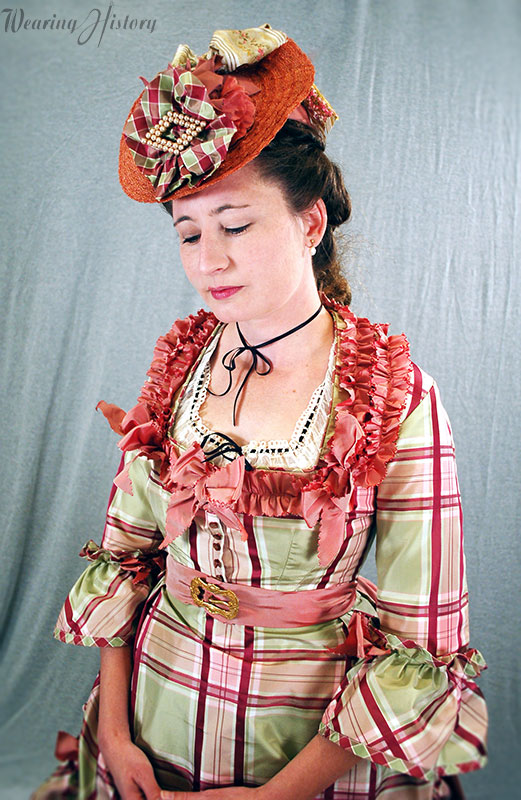
I finished it all up for the most part by the time my friend arrived, but since she had some extra sewing to do I started doing trimming.  And more trimming.  And more trimming.  Someone on the American Duchess Facebook album of Costume College photos said it looked similar to old fashioned ribbon candy- and you know, I have to agree!

This one was lots of fun to trim.  I love this time period.  I can trim, and trim the trims, then trim the trim with trims.  In this case the most fun things to make for trimming were the ruffles which were finished with a bias binding in the peach. Over the top of the ruffles at the side I ran a braid which was made of three tubes of bias made into cording and then braided.  The bows that are accented with tassels at the end were lots of fun to make, too.

This outfit was made using Truly Victorian patterns.  The bodice was made with Heather’s new 1872 Vested Bodice Pattern, TV403.  The skirt was made with the 1875 Parisian Trained Skirt Pattern, TV216 (you can see my previous version of the skirt in their website photo).  I’m a huge fan of Truly Victorian patterns- they make these Victorian patterns so accessible, and they make up really well!  I documented working on this bodice in prior posts here, here, and here.

Capturing the correct colors of this outfit has proved quite difficult.  In reality it’s probably a combination of the photos here in front of a blank background and the photos above.

The hat is actually a 1930s hat I had in my vintage collection.  At the last minute I remembered I didn’t have appropriate headwear so I pulled out this one, which just so happened to match perfectly.  I pinned little accents of the green onto the hat, added a pink feather and a few dress clips, and it suddenly became passable for 1870s.  The entire dress was made from polyester taffeta (gasp!) but the fabrics looked so much like authentic silk taffeta, even in person, and had the same hand to the touch, that I was able to make the dress look passable on a much better budget than by using a more authentic silk.  For a dress I’ll only wear on occasion, I decided it was a good sacrifice for me to make and it helped out my pocketbook ;)

That wraps up this project!  The End ;)

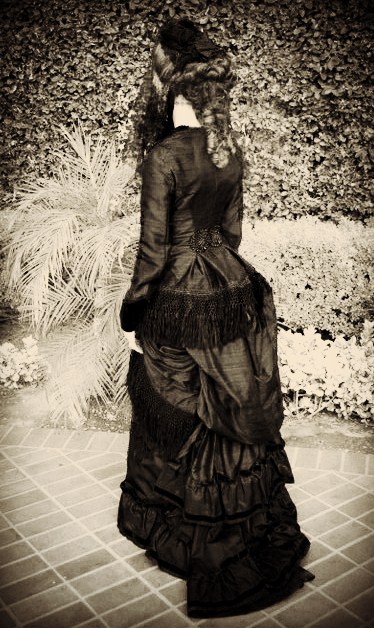
Finished Project: Natural Form Mourning Gown

First off- I absoultely LOVED reading all of your comments on my last post about what goodies you’ve found in your vintage patterns! So fun! Thanks for sharing your stories and finds :)

I realized I never got around to posting this outfit! Whoops?  This was another dress I made for Costume College, the annual costuming convention in California. I have a few more Victorian costumes I made for this event and I still haven’t taken proper pictures of them.

Actually, the theme of Costume College this coming year might be of interest to a lot of you.  The theme is the Golden Age of Hollywood: 1930-1955.  The bonus track will be focused on that time span, but there will still be a lot of classes focused on a variety of costuming interest, including historical costume.

This costume was made from Truly Victorian patterns. The bodice was a combination of a few of their patterns. Although I made this  a while ago and I don’t remember my exact changes, I believe I combined the 1880 Jacket Bodice pattern with the 1879 Curaiss Bodice pattern and lengthened the sleeves to long sleeves.

The overskirt was made with the 1880 Hermione Overskirt pattern and the underskirt was made from the 1878 Fantail Skirt pattern.
I started this project several years ago and got disgusted with the way it was turning out, so put it away in my closet and completely forgot about it until about a month before Costume College. I pulled it out and tried it on. At that time it was untrimmed and I needed to fix a few fitting concerns. It is trimmed with several antique black trims I had in my stash, including the fringe and the beaded appliques. The rest of the trims, including the looped edging and the velvet ribbon bands on the underskirt are new. The bodice and overskirt are made of silk dupioni. The underskirt is made of a faux silk taffeta. The buttons up the front are vintage. The revers on the bodice and the faux cuffs are stitched down accents from black velvet.
The hat, veil, and purse are antique.  I wore this over a very small bustle because I wanted the silhouette to be of the transitional period between early bustle and natural form.

In the end, I actually liked the way it turned out and I’m glad I revisited this project instead of just giving up on it and starting new :)

Have a wonderful weekend!

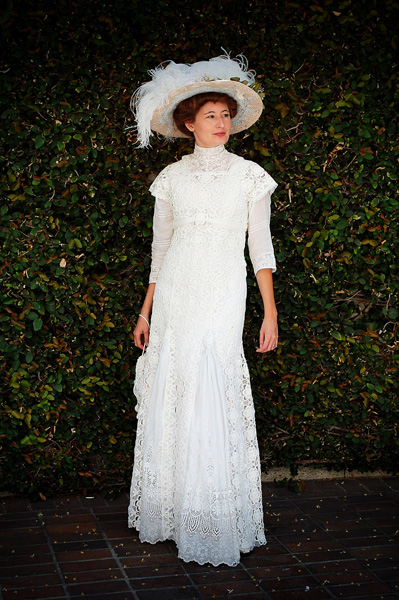
Finished Project- Edwardian Lace Dress

Continuing with the Costume College finished project posts, I’d like to share with you my Edwardian lace dress project.  This was probably the most fun and creative project I have made since I made my Edwardian dress project from last year’s Costume College.

I bought about 6 yards of this ecru wide cotton lace trim at the LA garment district earlier this year and ended up being positively inspired to construct a whole dress from this trim.  I wanted to somewhat mimic the feel of my original vintage lace wedding dress, but have this as a version I can wear to events and such without worrying about damaging an original.

Another trip the the garment district (I forget how many yards I ended up purchasing) and I started draping on my dress form the lace going in various ways until I came up with a version I liked and was simple enough to not be excessively busy.  I was inspired, in this case, by the simple elegance of many early 20th century all white dresses.

At first it took on somewhat of a 1930s feel. I had initially meant to leave it straight and do inset gores of lace, but after running out of the length and seeing that it would make the skirt too narrow and later looking than my original plan, I dug around in my stash and came out with some old eyelet embroidered cotton which was used as the insets on the front skirt.

To shape this to the figure I cut into the lace and applied it on top as appliques- similar to clipping out darts for shaping.  The whole dress was constructed with a wide zig-zag stitch, with edges abutting, and overlapping the cut out applique, as just mentioned.  It was actually not nearly as finicky as I thought it would be, as the lace was quite substantial.  In retrospect I wish I had taken construction pictures, but hopefully you can imagine what I am describing as I used up nearly every square inch in this project!

The insets of the lace were trimmed away to taper to a point and them applied the same was as the dart-like shaping, tapering from the full width to a single flower at top.  The two front insets are long rectangles which were run with several rows of shirring at the top and a cut out flower applique hides the raw edges at the top.

I wore this with my Edwardian hat I made several years ago.  I still love this hat- it is so fun to wear!  Under this dress I wore an original vintage blouse.  I had originally wanted to make a new reproduction blouse but ran out of time.  I did like the overall effect with the vintage blouse, though!

Many thanks to Jennifer from Historical Sewing, who had me as a model for her “Dressing the Silhouette” class at Costume College this year.  Since she signed me up for Edwardian it gave me the extra push to make myself a new pretty frock!

Also, many thanks to Jen of Festive Attyre for taking these photographs for me!

Finished Project- 1930s Dinner Dress

I’m back from Costume College! It was such a blast, and I’m somewhat sad to be back as I had a blast with all the friends I had not seen in a while but so overflowing with sewing inspiration from all decades and centuries.  What to sew next- an 18th century ensemble, a Regency ensemble, something 1890s… there’s just too many fun periods to play dress up!  Actually, I’m toying with going a bit earlier with patterns, too, but that’s a different story.

THANK YOU to the attendees who attended my class on Sunday! I was a bit nervous, but you all were so wonderful that I had a blast teaching and meeting some blog followers in person.  I will be posting some of the images from the class here on the blog, so stay tuned!  Another highlight for me was seeing a lovely gal in the 1930s Beach Pajamas! It was the first time I had seen anyone wearing something made from the patterns in person, and I ran all across the hotel lobby full of excitement!

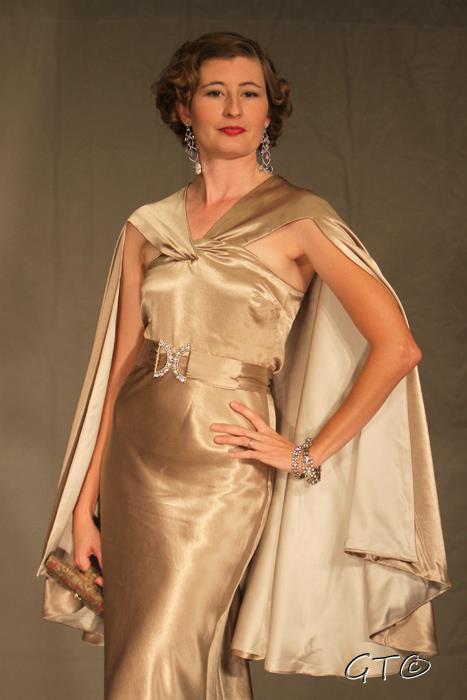
This is the dress I wore to the Saturday night Gala.  I call it my “Carole Lombard” dress (see inspiration photo here),  or “Super Satin” (name courtesy of a friend).  This dress was actually whipped up in 4 or 5 days of sewing, but I am SO thrilled with it!

The pattern I used for this dress was Eva Dress 744, her multi-sized 1930s dinner dress pattern.  It was a great pattern to use and I especially love the cut of the skirt.  I did make a few changes just based on personal preference.  Most notably I added 6 inches of length to the cape, cut the back skirt gore twice as wide as the original to have more “swoop” at the back, and added about an inch to the length of the top bodice between the bound buttonhole type facing that the cape passes through and the top, but did not add it to the lining (so that the top piece had more fabric gather above where the cape inserted, then tacked down a “tuck” to just add to the drapey effect).  Also, in lieu of making the cape detachable I decided to just go ahead and attach it and stitch closed the slit through which the cape passes.  I also cut the cape on the cross grain of my 60″ wide fabric so I could not have a seam up the back (which meant I had to piece the lining, but no biggie).

All in all this pattern was MUCH easier to make than I had anticipated.  The hardest part for me was inserting an invisible zipper at the side seam (hi, bias satin + zipper.  Ouch! What was I thinking?  It originally called for snap closures, but I wanted the smooth line), and the newest thing I had learned was zig zagging clear elastic at the back bodice to help it stay “put”.  I am glad I had thought of putting thread basting down the center front of the skirt and the bodice, as it helped me with fitting to make sure the skirt was hanging correctly. I am totally in love with the skirt of this pattern and can see myself adding it to various bodices for different evening gowns.

I used a great heavy gold rayon satin I purchased in the LA garment district for the body of the gown and cape.  The bodice and cape are lined in nude silk charmeuse.  Let me tell you, I was iffy about using my nice fabric to line this in because I was hording it, but oh my gosh, the silk charmeuse on my shoulders and arms felt SO nice that I’m glad I used it!


I love these close up photos of the various little details of the gown.  The belt buckle was from the LA garment district as well (hello, only $3!).  The cute authentic 1930s purse was purchased from a friend (Tottie on Etsy).  The bracelets were stacked, and they are both vintage as well.

SO many thanks to the very talented photographer, Gar Travis, who was generous to be the photographer of these images (excluding the top one) and let me post them here on my blog.  He does amazing work!  Make sure to check out his website http://www.garphoto.com/, where he posts more of his beautiful photographs from events.