James McCall was the founder of McCall Patterns, and while we know the patterns were established in 1870, very little is known about the man himself. We know he was an immigrant to the United States from Scotland, where he set up his pattern business, but most of his life was a mystery.
That is, until a random internet search led me to his death notice, placed in the New York Tribune on March 11, 1884. This announced that his death happened the day before, so we now know without doubt that he died on March 10, 1884. The notice reads as follows:
James Mccall
After one month’s illness from paralysis, James McCall died at his home, No 9 West Fourty-Second St, yesterday in his fifty-seventh year. Mr McCall was born in Blackburn, Scotland. His father died when he was a boy, and his mother was burned to death not long afterward. He was apprenticed to a tailor in Glasgow, and there learned his trade. Coming to this country he lived in Franklin, N, Y., several years, when he married and returned to Glasgow as the general agent of the Wheeler and Wilson Sewing Machine Company. He was successful in his undertakings and made money rapidly. He was the inventor of the well-known “Royal Chart” for cutting women’s dresses, and eleven years ago withdrew from the sewing machine agency and began the business at No. 48 East Fourteenth-st, for the manufacture and sale of patterns. He leaves a wife and daughter. The funeral will take place from his late home at 11 a.m. to-morrow. 1
His New York home address was No 9 West Fourty-Second Street. This was before the art deco renovation, and before it was the epicenter of the theatre district, as this address now shows a very art-deco style building, which the obituary would pre-date. There were, however, theatres still present. 19th century 42nd street seems to be a mix of residential, churches, and theatres. See here for photographs from the 1890s.
Wheeler and Wilson Sewing Machine Company
The obituary mentions that he worked as an agent for Wheeler and Wilson Sewing Machine Company. It can be assumed he moved back to Scotland for this job. Wheeler and Wilson was one of the first sewing machine companies, officially launching their machines in October 1853, though they had been making machines independently beforehand. In 1859 they produced the most sewing machines in the United States. They were eventually bought out by Singer in 1905, after James McCall’s time.2
The Royal Chart
Although information elsewhere online mentions James McCall as an agent in the USA for the Royal Chart, the obituary says he was the actual inventor. The Royal Chart was a cutting system, apparently invented in 1867. I found a very rough copy online, sold as an art print, that mentions a Mr. Elias Howe winning a prize at the Paris Exposition. Upon further research, I found an advertisement in 1867 that mentions it was invented by a Scotsman, which would be consistent with McCall.
The Royal Chart proposes to be something long desired by ladies, but hiterhto unprovided. It is a mathematical arrangement of lines, spaces and points upon a chart, whereby ladies are enabled accurately to cut the material for their won dresses, and with ease. It is the invention of a Scotsman, and is exhibited and sold here by Messrs Russell & Covert, New-York.3
Pattern Business Address
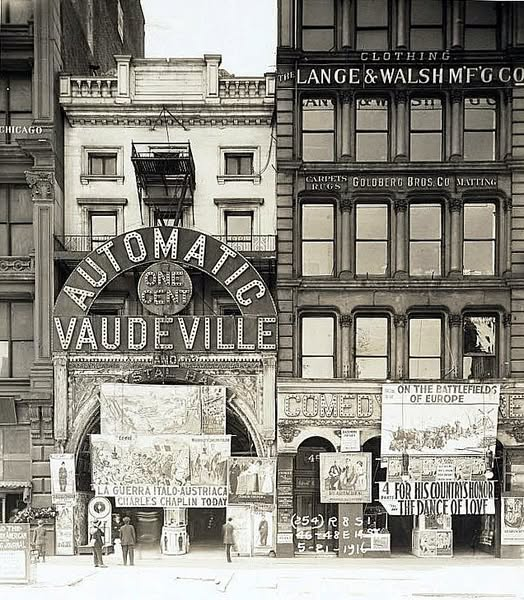
The pattern business address is listed in the obituary as No. 48 East Fourteenth-st. Although the buildings are gone today, I was able to find this photo from 1916 that shows the buildings the pattern business would have been in. At the time these were the American Vaudeville Company, a clothing manufacturer, etc. It is likely the pattern business occupied a unit inside the building, not the entire building, as it was only about 14 years old at the time of his death. During the lifetimes of McCall it seems to be home to several garment and dry goods related companies like Le Boutillier Bros,, dry goods merchant. 4
photo: NYC Board of Transportation, Bklyn-Manhattan Transit Co.
collection: New York Historical Society
The Pattern Company Name
It should be noted that McCall Patterns were not the original company name. They began as “Bazar Patterns”, “Bazar Cut Patterns6,” or “Bazar Glove-Fitting Patterns”5. The earliest advertisement I can find is on January 7, 18716, available at Wadsworth and Williamson (a shop), which can confirm that they were likely in production in 1870, the year given as McCall Patterns beginning, historically.
It’s likely he chose the name “Bazar”, as Harpers Bazar was a popular periodical which provided a pattern sheet of overlapping lines, similar to La Mode Illustree, or Burda today. Eventually the name morphed to “Bazar Patterns by James McCall”, or “McCall’s Bazar Patterns,” until it eventually became known as “McCall Patterns”.
But what about his prior years?
Now that I had a death date, I easily went onto Ancestry, plugged in the information, and was able to obtain his birth date.
- James McCall was born on July 12, 1826 in Dumfriesshire, Scotland, according to an Ancestry user. The approximate birth year is confirmed by the census records.
- In the 1841 Scotland census he is listed as 15 years old, working as a draper’s assistant and lived at Harries Close, Dumfries, Scotland. He was living with William Murdoch, a Coachman. According to his obituary, his father died when he was young, and his mother was burned to death shortly afterward. This explains why he was not living with his family at fifteen.
- He was married to Laura Sophia Ford, according to North America, Family Histories, 1500-2000. She was born October 8, 1823 in New York, and she died on October 12, 1896 in Manhattan, New York. I wasn’t able to find a marriage certificate.
- Their daughter Anna Bell McCall, also written as Abigail or Annie, was born around 1854. I believe they are the same person, as the birth date is the same year. Her death was given as 1883, which would be consistent with the obituary, as only one daughter was listed in 1884, when James McCall died. However, I was unable to find birth or death records and this information was based on census information.
- A second daughter, Fannie McCall, was born around March, 1868 in New York. She married Dr Dillon Brown on October 20, 18927 . According to the last will and probate records, Fannie was an adopted daughter. Her marriage announcement7 tells of her wearing a lovely gown of ottoman silk in walking length, and her mother gave her away as her father was not living (in 1892).
- In the 1870 United States Census he lived at 145, 3 Election District, 19th Ward, New York. He is listed as a “Dealer in Sewing Machines”, age 46. His personal estate value was $10,000 (approximately $250,000 in 2025) and born in Scotland. He was living with his wife, Laura, age 41, who’s occupation was “keeping house”, and daughter, Annie, age 16. They had four domestic servants living with them, all originally from Ireland. Their names were Margaret Conlon (age 23), Bridget Slattery (age 26), Annie Lawler (age 20), and Margaret White (age 23). The spelling may be a bit off on their names, as old script can be challenging to read sometimes. The census was taken on June 4, 1870.
- In the 1880 United States Census James McCall (age 57) was living at No 9, West 42nd Street (the same as the obituary). His wife, Laura (age 52) and daughter, Fannie (age 12), were living with him. Notably, his profession is listed as “Bazaar Patterns”, which was the name McCall Patterns were known as, previously. His birthplace is still shown as Scotland. The birthplace of both his daughter and wife were New York. They had two servants living with them, Mary Griffin (30), and Kate Doyle (28), both originally from Ireland.
- The first daughter, Anna Bell (Annie), does not appear on the 1880 census, it’s likely she had moved out by 1880, as she would have been about 26 years old. I see a death date for Abigail McCall of 1883, but no source yet.
- On March 10, 1884, James McCall died. The cause of death was given as paralysis. I found he was a Member in Full of St Luke’s Church, a Methodist church in New York. He was buried at Ouleout Valley Cemetery, Franklin, Delaware County, New York, United States of America. This image was given by a member of Find A Grave. I don’t know why he was not buried in Manhattan- or if this is just coincidence that this James McCall has the same death date and wife’s name. Very unlikely it is coincidence.

Will and Probate
The will and probate is given on Ancestry8, and in a script somewhat difficult to read. There is no specific mention of the pattern business, but we do learn that Fannie was an adopted daughter. James McCall left one half of his property and estate to his wife, Laura. The second half of his estate and property he also gave to his wife, including collecting rents, issues, and profits, until she died, and from there she was to give it to his adopted daughter, Fannie. The will was dated August 15, 1883.
What Happened to the Patterns?
It should be noted that McCall began a “The Queen” magazine to accompany the patterns in 1873. At the time of his death, James McCall had periodicals and sewing patterns as part of the company.
I cannot find who ran the company directly after James McCall’s death. As always, research is ongoing. It’s likely his wife was the primary owner.
I found an advertisement for the McCall periodicals in December, 1891. It lists the publications as “The Bazar Journal and Mother’s Assistant”, “The Bazar Dressmaker” both of which had the option of adding a copy of a McCall’s Celebrated Bazar Glove-Fitting Patterns. There is also “The Queen of Fashion”, which would become McCall Magazine later on. Most interestingly, the company name given is Jas. McCall & Co., 46 E. 14th St. (Union Sq), New York.13 This is just next door to the address given on James McCall’s obituary.
In 1893 the McCall company was sold to James H Ottley9. This was three years before the death of Laura McCall, James’ widow. As of now, the obituary is the only source that mentions the year of sale. However, it was known as “The McCall Company” after 1893, instead of “Jas. McCall & Co”.
Ironically, in 1895 I see that Dillon Brown, Mrs Fannie McCall Brown, and Clarence M Foster incorporated “the Van Publishing Company” to prosecute a publishing and printing business in New York10. It seems James McCall’s daughter followed in the publishing footsteps, and they began a company that starting publishing a magazine about raising children and nursery topics. I cannot find them prosecuting, in the legal sense, for McCall Magazine.
In 1897 “The Queen” magazine was renamed “McCall’s Magazine”.
Mr Ottley was owner of the company until 1913, when he sold it to “a group of capitalists.”9 The company is listed as White, Weld & Co, who organized the McCall Corporation with a capital of $6,750,000, renaming it from The McCall Company. It included the sewing and embroidery patterns, McCall’s magazine, and McCall’s Quarterly Book of Fashions12. Mr Ottley remained as one of the directors.
Mr Ottley, following his retirement he gave a total of $100,000, split among anyone who had been at the company for more than three years. It as distributed among 300 employees (there were 800 employees total)11.
As far as I know, I may be one of the first people to track down more information about James McCall’s family background, as the inventor of McCall patterns. All of this research was compiled from period sources including newspaper articles and advertisements, censuses, state documents, and Ancestry. If referencing this information, please credit my research.
Sources
1 Obituary, James McCall. (1884, March 11). New-York Tribune, p. 5.
2 Wheeler & Wilson – Wikipedia
3 Advertisement, Royal Chart. (1867, October 27). The New York Times, p. 8.
4 Advertisement, Le Boutillier Bros. (1876, April 10). The Brooklyn Daily Times, p. 4.
5 Advertisement, Emporium of Fashion. (1873, May 31). The Buffalo Commercial, p. 2.
6 Advertisement, Bazar Cut Patterns. (1871, January 7). Democrat and Chronicle, p. 4.
7 Weddings of a Day, Brown-McCall. (1892, October 21). The World, p. 10.
8Record of Wills, 1665-1916; Index to Wills, 1662-1923 (New York County); Author: New York. Surrogate’s Court (New York County); Probate Place: New York, New York
9 Hold Services To-Day for James H. Ottley. (1922, March 5). New York Herald, p. 17.
10 Another Publishing Company. (1895, October 16). Mount Vernon Argus, p. 2.
11 Gave His Employees $100,000. (1913, March 22). The Kansas City Star, p. 6.
12 McCall Corporation. (1913, February 18). The Inter Ocean, p. 8.
13 Biggest Offer Ever Made. (1891, December 20). St Louis Post-Dispatch, p. 10.
Tracy Glen
October 3, 2025 at 2:20 pm (7 months ago)So cool! Thank you for this information. I have some ancestors in my tree who were pattern makers, and also have Scottish heritage. This makes me want to learn more!
Caroline Nelson
October 3, 2025 at 2:55 pm (7 months ago)Ohhh I really want to go to his birthplace for the 200th anniversary (I am in Scotland). Maybe we could have a little celebration. Thank you for all the researches.
Zoe
October 3, 2025 at 10:20 pm (7 months ago)Fascinating and thoroughly researched, thank you!
Nicole
October 10, 2025 at 9:21 pm (7 months ago)Very. interesting!