I came across this article today while researching a pattern label question in Vintage Sewing Pattern Nerds on Facebook (great group, if you’re not already in there), and found it interesting. Typing it out here so others can learn from it as well. I find particularly interesting how many patterns were sold and what the most common sizes were. No wonder we find so many patterns in sizes 32″ and 34″ bust!

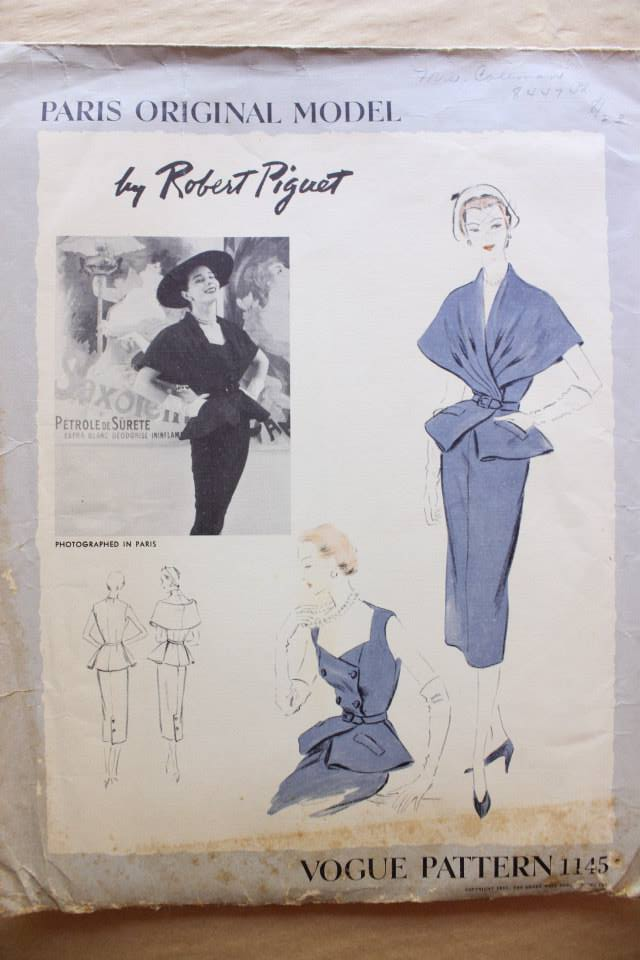
Above example of a Vogue Paris Original model, from my collection.
From Winston-Salem Journal, December 18, 1955. By Gay Pauley, United Press Staff Correspondent
“NEW YORK, Dec 17 (UP).– High fashion has come to the home-sewing market but still has a long way to go before it takes over.
The woman who makes her own wardrobe now can, if she wishes, wear a Paris design just as readily as the woman who goes all the way to Paris to shop.
One pattern company said it can have patterns ready for a new French fashion within a week after it is shown in Paris. Several companies boast of the “name” designers they work with in New York, Los Angeles, San Francisco, Paris, Rome, Madrid, Dublin and London.
But two firms, Simplicity and Butterick, are big exceptions to the pattern markers who feature a “haute couture” styling.
SIMPLICITY SAID it does not go to Paris for ideas; that the American woman who makes her own clothes couldn’t care less about what Paris is doing.
“I doubt if 20 American women out of 10,000 know who Christian Dior is,” said a Butterick spokesman. “Certainly, we keep track of the trends in the ready-to-wear market. But we think women want good style, fitted to their figures. They are not interested in a label for label’s sake.”
But other firms– Vogue and Advance, to name a couple– have contracts with top designers in America and Europe for line-to-line copies of certain of their originals. Advance said it keeps a representative in Paris, just to cover openings of the top houses, relay the trends to New York, and put the company’s own design staff to blueprinting the latest for the American seamstress.
ADVANCE SAID it can have the pattern for a new design on the counters in a week after it first is shown, if a trend is important enough to warrant a rush copy.
“We stick our neck out with a style, the same way the ready-to-wear market does,” said Eric O Dick, vice president.
All the pattern companies have their own design staffs. Their contracts with couturiers might be called a supplement to their overall production.
Simplicity alone comes out with 40 patterns each month, or about 500 annually. A top designer may have only 30 or 40 numbers in a collection, and there usually are two collections a year.
But the American woman uses up a lot of designs. It has been estimated that 38,000,000 women sew, using more than $1,000,000,000 in fabric yearly, and that if the pattern envelopes were placed end to end, they would cover 12,000 miles.
Top-selling size is 14, indicating that the American woman is slimmer these days. Size 16 was the best seller before World War Two.”
Wearing History Notes- For reference, a mid 1950s size 14 was Bust 32, Waist 26, Hip 35. A pre-WWII size 16 was Bust 34, Waist 28, Hip 37.
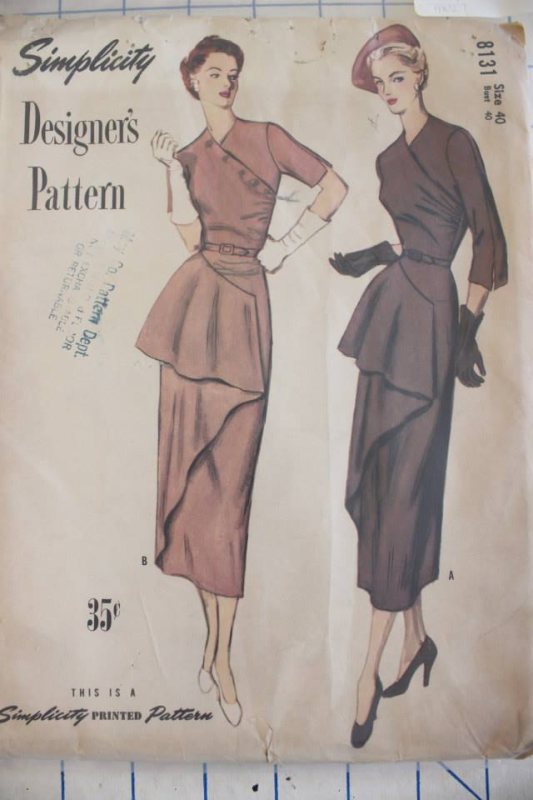
Simplicity did have a short-lived designer pattern line from 1949 through the early 1950s. These patterns featured the larger pattern envelopes like Vogue Couturier patterns but were usually published without designer names.
Advance also had the larger designer patterns called “Advance Import” during the 1950s, though these changed to the smaller envelope size later on, and sometimes had the designer names attached, but not always.
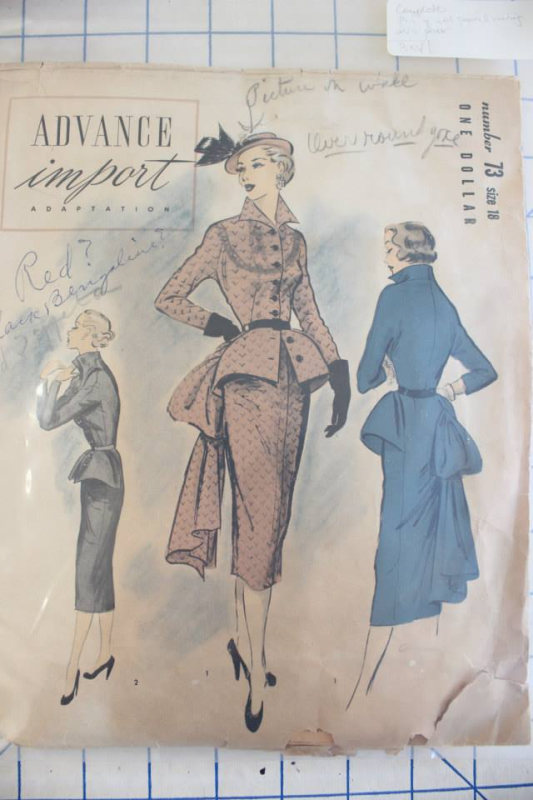
Example of an Advance Import pattern.
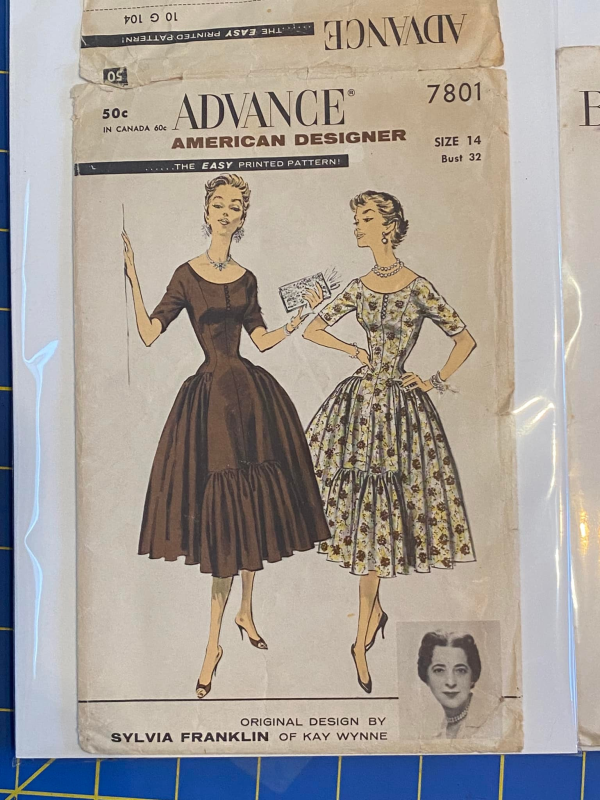
Example of an Advance American Designer pattern, in traditional envelope size.
All pattern photos from my personal collection.