Finished Project: Blue Corset from 1868

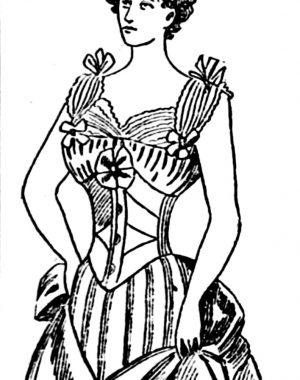
I just put the finishing touches on this today, and I’m so glad to finally have it done!  I started the mock up for this sometime last year.  I really wanted a corset I could wear to get a decent silhouette for late 1860s/early 1870s gowns.  I have one Victorian corset I made myself, but it’s more appropriate for the 1880s and didn’t give me much form.  I started reading up about how women who weren’t endowed got their shapes, and talked to other costumers about it.  Jen of Festive Attyre was especially helpful in figuring out what to do.  This corset has sort of revolutionized my thinking about making them, and I’m glad to say that I’m no longer paranoid about making corsets.  It was revolutionary to me to realize that I could make myself fit a corset shape, and fit a corset to fit *me*, when my shape is so not what was the period ideal for the Victorian era.

When I started thinking about this project I knew I wanted a blue corset, like in Edouard Manet’s painting Nana, from 1877.  Although later than this corset by nearly ten years, I have always loved this painting and knew I wanted to mirror this color scheme when I made mine.

The pattern for this corset came from Francis Grimble’s Reconstruction Era Fashions book.  It was reproduced from an original Harper’s Bazar pattern from 1868 and then scaled down by half.  I re-enlarged the pattern and did my mock up. I found in the mock up stage that the original sizing of the corset pattern was several  inches too big for me, so I did some adjustments at the side seams, and some smaller adjustments to the hip and bust gussets, but made sure to leave enough room and not over fit it, so that I had room to pad out to achieve close to a period shape.

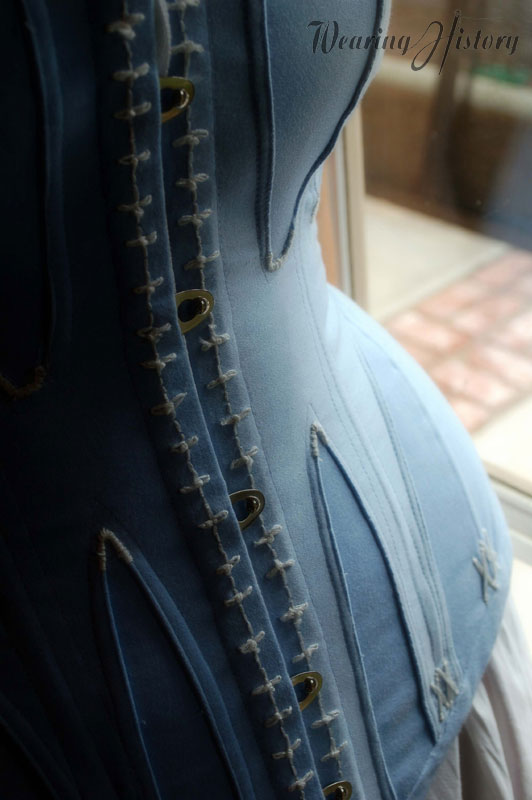
The original pattern called for boning across the back, but I decided I would rather have cording as I thought it would be both more comfortable and more decorative.  My husband was a darling and did the grommets up the back for me.  That’s one thing I really don’t like to do!  The chemise I am wearing is an antique in my collection.  Although I wouldn’t really wear it under clothing for fear of damaging it (although it is quite sturdy), it was fun to wear for pictures.  I need to make one along similar lines someday.

I should also mention that when I went to do my boning channels I realized I missed a tuck that was called for that went from the bottom of the front bust gusset to the bottom of the corset.  Oops?  Since I had already done all my fittings without this tuck I just decided to leave it be, but that accounts for one of the bust gores having a squared off shape at the bottom rather than a point.  Doesn’t bother me, but in case others wanted to try this pattern I thought it should be mentioned.  And as with all period patterns of this age, no seam allowances were included in the original pattern.

The fabric I used was white cotton coutil, to which I flat lined blue cotton sateen.  I was sick for quite a few days last week, so I used the opportunity to do something I don’t usually do- and embroider a little motif up the front of the busk and add some flossing.  I don’t have much skill at this sort of handwork, but it was fun to do and I think it looks kind of pretty!  My initial thought was to do flossing and add a contrast binding and wide lace at the top, but I really like the simplicity of these accents and I’m glad I didn’t go with my first plan.

Just like today, women would pad out what nature didn’t give them naturally.  As I mentioned previously, I was on a quest to get a bit more of a Victorian shape than I had naturally or with my previous corset.  When I took my mock up of this corset to work with me, I had some help from a theatre perspective and found that they still use this trick. One of the “tricks of the trade” are to use men’s tailoring shoulder pads and place them strategically at the sides, both at top of the corset, and at the bottom, to create more of an hourglass shape.  Then you can use little pads in the front for extra support- to create a bit of a shelf.  I tried this, and lo and behold, I actually had a decent shape for the era! Much better than I had had previously.

Since this project was done in conjunction with the Dreamstress’ great group, The Historical Sew Fortnightly, here’s the info required.

The Challenge: Under it All

Fabric: Cotton coutil, cotton sateen

Pattern: Reproduced Harper’s Bazar pattern from Frances Grimble’s Reconstruction Era Fashions Book.

Year: 1868

Notions: Metal spiral and flat steel boning, corset busk, grommets, corset lacing, cotton embroidery floss, stay tape, thread, set of pre-made shoulder pads, cotton quilt batting to make two more pads, white muslin to cover shoulder pads.

How historically accurate is it?  Looks accurate on the outside (embroidery inspired by, rather than reproduced authentically from, period examples), but the inside and construction are done with modern methods.  The gussets were flat lined then serged, and applied with  lapped seams rather than flat felling.

Hours to complete: Several.  From start to finish, perhaps around 10 hours, including several mock ups and time to enlarge and alter the pattern.

First worn:  Not worn yet other than for photos

Total cost: Didn’t keep track but I’m guessing $35-40ish, not including the book cost.

Finished Project: The Tissot Dress

Fair warning- this is a long and picture heavy post!

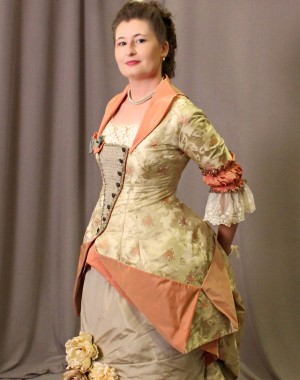
This dress had been a long time on my wish list.  I’m an ardent fan of James Jacques Tissot’s paintings, and a particular dress that appeared in a few variations in several of his paintings really inspired me.  The dress is not an exact copy, but is inspired by the following paintings.

This was the first one I found, called The Gallery of H.M.S. ‘Calcutta’ (Portsmouth), 1877.  This image is from the Hermitage Collection Connection’s blog.  My good friend is eventually going to make the one in blue so we can go about together in our ensembles :)

 Then I found several more paintings in which this image appears:

Portrait of Miss Lloyd (on left) from loveisspeed.  July (on Right) posted by a friend online.

July: Specimen of a Portrait from Flickr (on left), Fete Day at Brighton from Wikimedia Commons (on right) has different color bows but is the same dress.

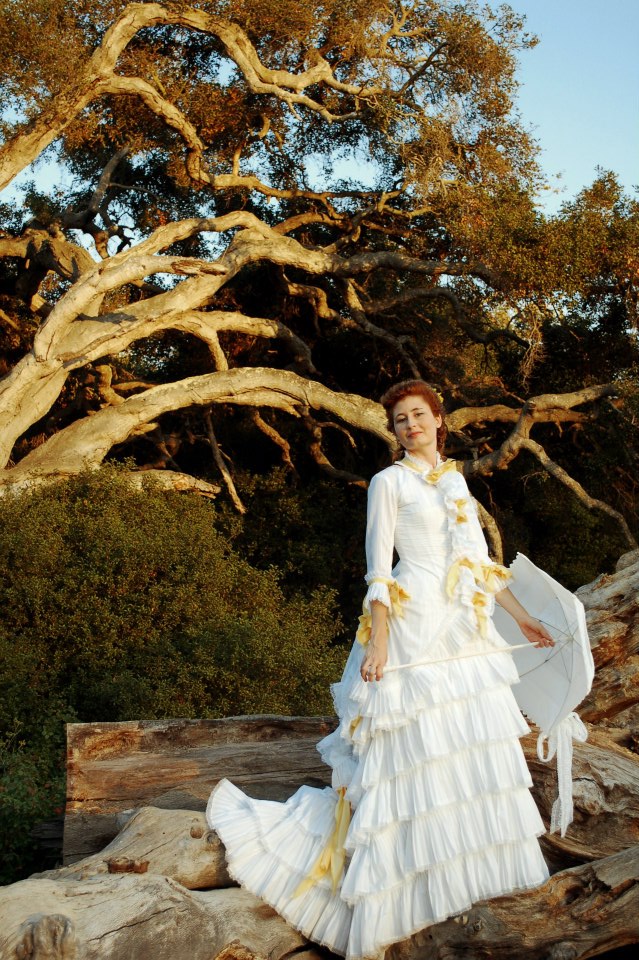
  I started this dress in June of last year and actually did wear it to Costume College last year, but only for an hour or two, during which I taught a class.  After Costume College last year I finished it up and meant to take pictures the entire year, but after a bit of thought decided I liked it too much to not wear again, so it made another (longer) appearance this year.  The photos below combination of photos taken at Costume College this year and afterward at a public park.

The skirt was made from the Truly Victorian natural form Fantail Skirt pattern.  I wanted this to be a transitional dress between early bustle and natural form, so I actually tied the back of the skirt looser (it’s on a drawstring) and fit it over my Truly Victorian Petticoat with Wire Bustle, and tied the tapes inside the bustle somewhat loosely to have a smaller bustle shape.  The “polonaise” was made using the basis of Truly Victorian bodice shapes and I compared the cut with several in Francis Grimble’s Fashions of a Gilded Age (I don’t remember if it was book 1 or 2).  Since I am already familiar with the cut of Truly Victorian bodices I found this to be easier than scaling up and fitting a bodice from an original pattern I wasn’t familiar with.

The skirt and polonaise are both accented by pleating that is edged in lace.  The front fastens up the center front with hook and eye tape, and the bows are taffeta cut into bias strips and then tacked on.  The dress is made from a cotton/poly blend.  I was told it was all cotton when I purchased it in the Garment District in LA, but boy- was pleating it a pain!  I used the Perfect Pleater, but since it had poly in it, it did not want to hold the pleats.  In the end I used a combination of vinegar/water to set the pleats- sprayed it heavily and ironed the pleats in until they were well dry.  I waited for it to cool.  I then did a heavy coating of spray starch, gave it a second to set, then ironed it well (too soon after spraying and it would stick!), and then waited for that to cool.  Part way though this project I realized how beneficial a press cloth can be!

Yes, it took FOREVER and is not something I’d like to repeat soon.  I’m actually unsure of the yardage. I just kept going until I ran out of fabric! I’d still like to make the matching jacket but I ran out of fabric.  I just saw it again on the last trip to LA, but forgot why I wanted it.  Of course, now I remember! I hope they still have it whenever I go back- I went on a wild goose chase last year trying to find the darn fabric again with no luck!

At the last minute before Saturday at Costume College I remembered I didn’t have a hat so threw one together very quickly with fabric scraps and hot glue on a straw base bought from Truly Victorian when they sold these.  My husband painted it white for me last summer.

I just posted my favorites here (and I know there’s a lot) but I have several more photos of this dress on Flickr which aren’t in this post.  You can see them here.

This dress feels like a dream to wear. I just adore white dresses from the Victorian and Edwardian eras!  I need more excuses to pull this one out in the future

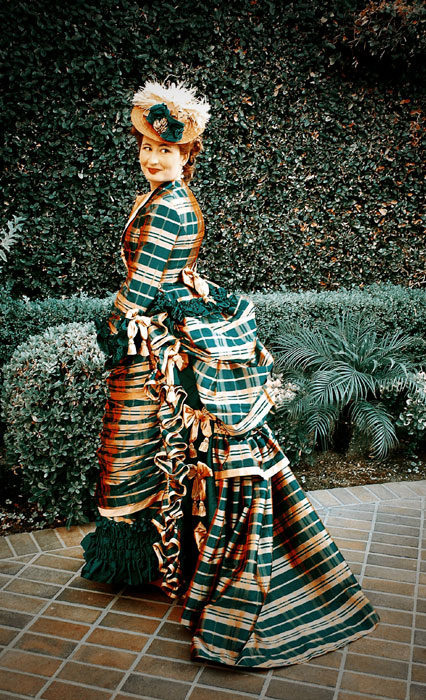
Finished Project: The 1870s Green Plaid Bustle Dress

I’m back from Costume College, my good friend is on her way back home to Texas, and it’s time to get back to real life. Woe!  But I have some fun photos to share coming up, and the first of which I want to share is the 1870s plaid bustle dress project I posted about previously.

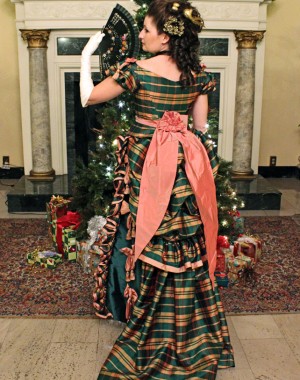
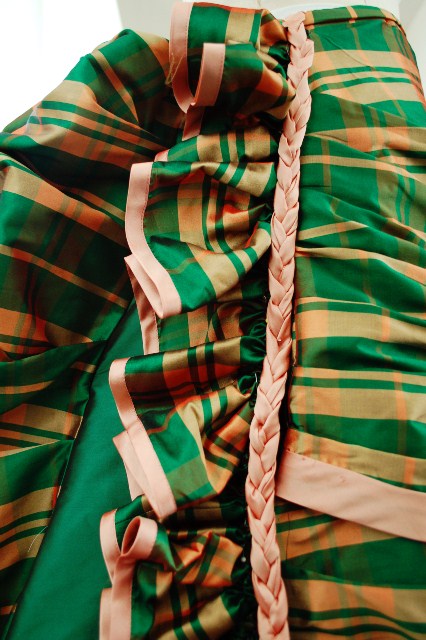
I finished it all up for the most part by the time my friend arrived, but since she had some extra sewing to do I started doing trimming.  And more trimming.  And more trimming.  Someone on the American Duchess Facebook album of Costume College photos said it looked similar to old fashioned ribbon candy- and you know, I have to agree!

This one was lots of fun to trim.  I love this time period.  I can trim, and trim the trims, then trim the trim with trims.  In this case the most fun things to make for trimming were the ruffles which were finished with a bias binding in the peach. Over the top of the ruffles at the side I ran a braid which was made of three tubes of bias made into cording and then braided.  The bows that are accented with tassels at the end were lots of fun to make, too.

This outfit was made using Truly Victorian patterns.  The bodice was made with Heather’s new 1872 Vested Bodice Pattern, TV403.  The skirt was made with the 1875 Parisian Trained Skirt Pattern, TV216 (you can see my previous version of the skirt in their website photo).  I’m a huge fan of Truly Victorian patterns- they make these Victorian patterns so accessible, and they make up really well!  I documented working on this bodice in prior posts here, here, and here.

Capturing the correct colors of this outfit has proved quite difficult.  In reality it’s probably a combination of the photos here in front of a blank background and the photos above.

The hat is actually a 1930s hat I had in my vintage collection.  At the last minute I remembered I didn’t have appropriate headwear so I pulled out this one, which just so happened to match perfectly.  I pinned little accents of the green onto the hat, added a pink feather and a few dress clips, and it suddenly became passable for 1870s.  The entire dress was made from polyester taffeta (gasp!) but the fabrics looked so much like authentic silk taffeta, even in person, and had the same hand to the touch, that I was able to make the dress look passable on a much better budget than by using a more authentic silk.  For a dress I’ll only wear on occasion, I decided it was a good sacrifice for me to make and it helped out my pocketbook ;)

That wraps up this project!  The End ;)

TV403- We Can Have Buttons!

Last night I finished up my facings, made my buttonholes and sewed on my buttons. It’s just about wearable now, but I still want to add more trim if I have time.

The buttons are vintage or antique ones I picked up at The Vintage Marketplace, a shabby chic/vintage flea market that happens a few times a year where I have a booth.  Luckily there are a lot of buttons, because I still need to make two more buttonholes and buttons!

Next up: hem the skirt and add trim.  I most likely will not be posting more pictures of this until after the event, but you won’t have to wait long as it’s less than a week away!

TV403 Bodice Progress

I’m plugging along on this bodice! This is Truly Victorian 403, the new 1872 bodice.

I am crazy and picked a giant plaid, which has made things more difficult than they needed to be.  But I’m pretty happy with it so far!  I am different proportions than my dress form, and the sleeve hangs differently on my body, but you’ll  just have to take my word for it- it fits me better than it does my form.

The sleeves were such a pain! For some reason I always have problems getting the sleeves of Truly Victorian patterns to fit me (though I absolutely adore Heather’s patterns), so I had to alter them significantly.  But also, figuring out the cut of the plaid was difficult. And then there was actually sewing the things! I ended up machine sewing the underarm, then putting it on my dress form and pinning the sleeve to place, then hand sewing the sleeve caps in so I could get the pattern to match up how I wanted it to.

On to the next steps! I’ve got to finish the bodice facings and hem, then on to fastenings!

Busy, Busy, Busy- and Lots of Sewing

I’ve been a bad little blogger! I’m around, but I’ve been frantically working on some projects!

First of all, I finished up one of the two vintage gowns I’m making that I spoke about in the Hollywood Inspiration post.  The other one is all finished except for some trim.

Then I madly started making the new Truly Victorian bodice, TV403, the 1872 Vested Bodice.

And because I’m just *that* crazy, I am making it out of a giant plaid.  But check out my skills of a plaid matcher- that’s a front with two darts, a side piece, a side back piece, and a center back piece with a seam down the center. Next up is cutting the two piece sleeve.

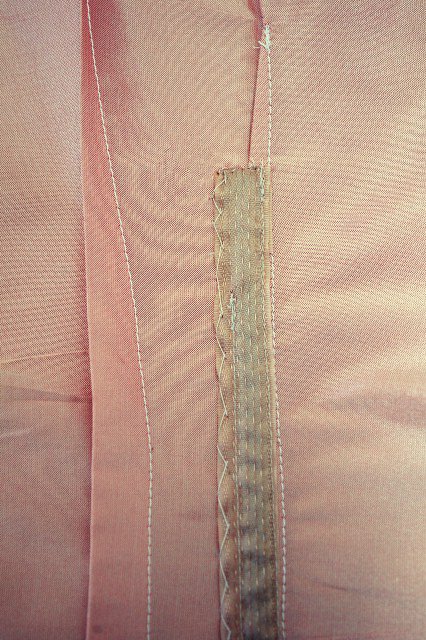
I’ve also been doing crazy things like making neat little handstitches on things that will never be seen (not even by me) because it’s sandwiched between two layers of fabric!

Here’s hoping it actually gets done in time.  I’ve still got work on my classes I’m teaching to do, too! Eep!

Bustles, Books, and Gardens

Hello!

I’ve been puttering away on an 1870s bustle ensemble using green, peach, and plaid.  Here’s a little peek- the ruffles and trim are just pinned on right now. I’m using the Truly Victorian Parisian Trained Skirt pattern. I’ve made a skirt from this pattern once before and really love it.

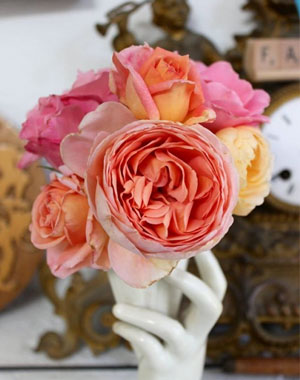
I’ve been spending some time outside playing with flowers and reading.  I’m still making it through the Anne of Green Gables books and am about halfway done with Rainbow Valley.  I love L.M. Montgomery’s books. Reading them is like visiting with old friends.

The Aloha rose is a new addition to our garden. I’m waiting impatiently for the bloom to open!

Hope you are having a beautiful week.

This Easter’s Hats and Bonnets- Ladies Home Journal- April, 1897

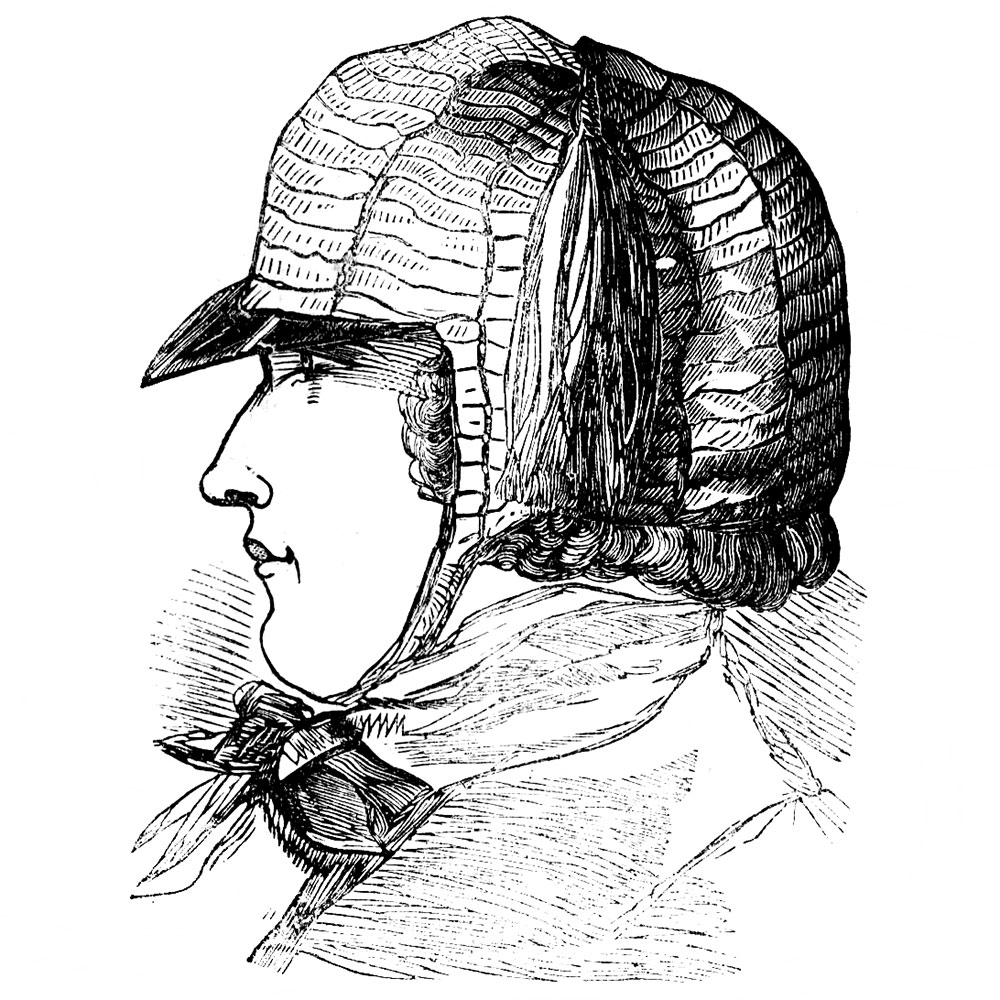
If you’re following me on Facebook you may have seen a photo I posted this week of a lovely find I recently received in the mail- several years of bound Ladies Home Journal magazines.  I have been itching to share some of the content with you, so today we’ve got hats and bonnets from the April, 1897 issue.  The layout of this page made it quite hard to share a scan (the magazines are a large format), and the layout was bizarre with very small pictures, so I have transcribed the article here, complete with the remastered pictures a little larger than they appeared in the original.


The fashionable materials for this Easter’s hats and bonnets are chip, manilla, Leghorn, Neapolitan, Madagascar and English straw, and all the straw braids, especially those imitating satin.  Black velvet is largely used for trimming with moiré and stain ribbons, deftly looped.  Ostrich tips and long feathers are in vogue, though flowers are given preference over everything.  The big Parma violets, as well as the enormous roses and poppies that were so generally used last season, continue to obtain, while camellias, tuberoses, white lilies, lilies-of-the-valley, blue hortensias, ragged robins and primroses are counted as quite new.

An extremely smart little bonnet (no. 1) is made of dull red straw, the front being turned back, exposing the hair, somewhat after the fashion of a Scotch cap.  Very slightly to one side of the front is a bunch of black ostrich plumes, caught in place by a Rhinestone clasp.  The simplicity of this bonnet is its special charm, while its style is cited to show that the woman who looks best when her hat is off her face has been considered.  A little bonnet (No. 2), which may or may not have ties, has a small frame covered with a drapery of white satin embroidered with jet, turquoises, and silver spangles.  It is raised on the left side and decorated with pink camellias and one large black silk poppy.

Click the link below to continue reading. If you see no link, you’re in the right place!

Continue reading

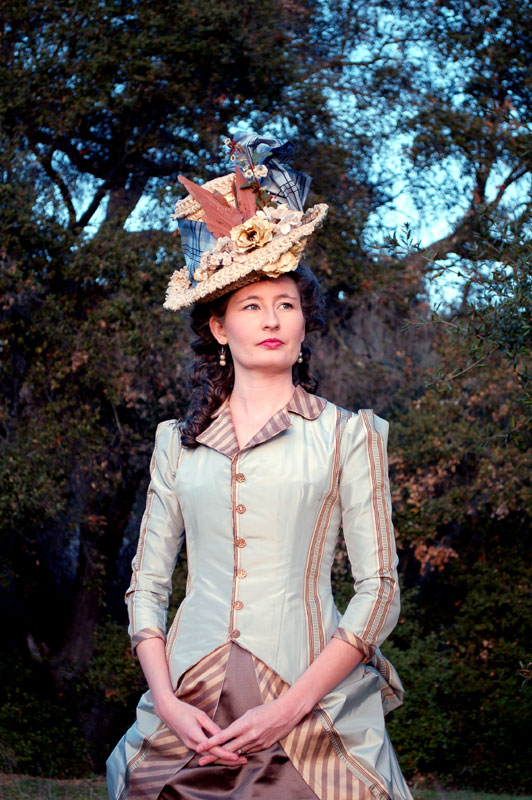
Finished Project: 1880s Bustle Dress and Hat

My husband and I finally took proper pictures of this dress I finished last year!  This was my favorite dress I made last year, and it’s my first dress from the 1880s that I’ve made that I’ve been happy with.

I posted previously about making this dress here, here, here, here, here, and here.  I also posted the hat here.   This was one of the largest personal projects I tackled this year, second only to the white Tissot inspired dress that I’m hoping to take pictures of tomorrow (or soon, anyways).

To recap on patterns:  I used the Truly Victorian Wash Overskirt pattern, the 1885 Truly Victorian Four Gore Underskirt pattern, and I kind of miss-mashed several different Truly Victorian bodice patterns to make the bodice.  Of course, the patterns were modified to suit what I wanted to do. The underskirt pattern was shortened and then made to have the points and I attached the pleating under that- but I think I wrote about that more in previous posts.

The excuse to make this outfit was to wear to Costume College, an annual costuming convention held in the Los Angeles area.  I’m glad I had the excuse, as I always am most happy with the historical sewing projects I make during the year, and I don’t always attend enough events or do any flitting around the house in 19th century attire.  The dress was a combination of a bunch of fabrics, all from out of my stash and bought as remnants here and there, aside from the silk that the skirt was made from which I found for a shocking $3 a yard in the garment district in LA!  My big splurge on this was the blue striped silk taffeta, which was a whopping $5 a yard.  The dress just kind of came together after all the fabrics had a few years to mingle together in the stash and inspiration decided to strike.

This hat is SO much fun to wear, but it is an awful bear.  It makes me stand up tall in order to keep it on my head! lol!  I still need to fine tune my millinery skills- I have a tendency to make hats a little too small in circumference- especially after I add a period hairstyle or wig.   I know it’s a little big and a little over the top, but it’s FUN.  I like big hats with lots of stuff on them.


We had so much fun taking the pictures! The dress is so fun to wear and makes me feel pretty and fancy- like a heroine in a BBC period drama :)   So, of course, I’ve got to add some silly shots to the end here of my oh so period correct socks, and just being silly.

Ta Da! My 1880s Bustle ensemble.  On to more costuming adventures! I may have possibly started sewing an 1869 underskirt last night to go with an ensemble I started over 5 years ago. ;)


Victorian Novelties, Part 2- Things that Go “BANG” in the Night

Continuing on with the odd novelties, and in the vein of “trick or treat” for Halloween, here’s a few more little tidbits from a 1900 catalog.  You can see the prior post here.  I’m trying to screen these old ads for things that might be socially unacceptable or offensive today, but an occasional thing might slip in that I missed.

Things that go “BANG” in the night (or day)

And for a different kind of spark…

Here’s hoping we’re back and rolling, and you all can see this post properly!

Just in case you’re seeing this in your reader and not on the site, the blog address is http://wearinghistoryblog.com.  If for some reason the posts aren’t showing up for you, you can subscribe to the RSS feed from the site- there’s a little orange icon on the right column on the main page (click the top banner if you click in on the post address).  Sorry for the mix-up, and hopefully now everything is running smoothly!