Finished Project: Jenn’s Wedding Reception Dress

I broke my usual code of not sewing for other people!

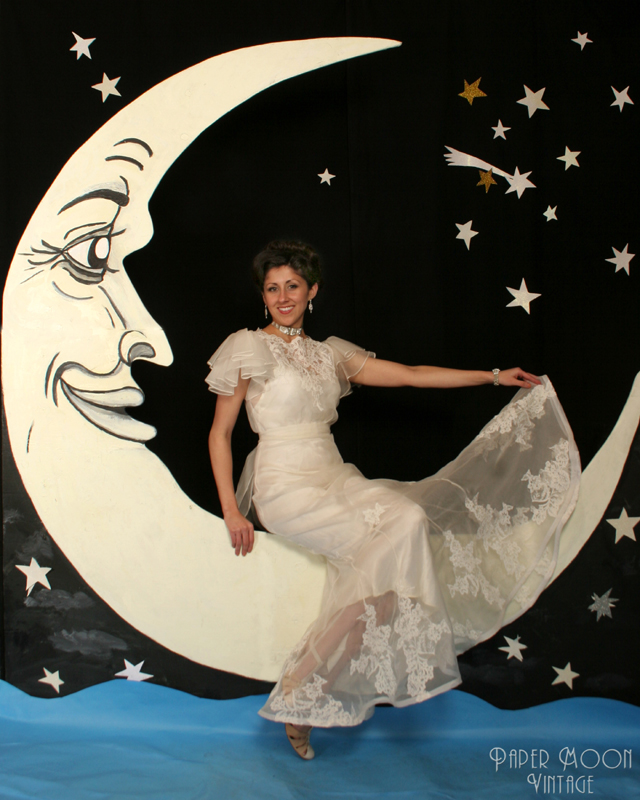
That’s right, I made another wedding dress.  I thought I’d be laid off for a month, and a lovely friend was getting married and could not find anyone to make her dress, so I volunteered.  Jenn wanted a 1930′s dance dress Ginger Rogers would be proud of.  We shared images, brainstormed, and finally came up with a design by cobbling together odds and ends of various vintage patterns to get together a dream dress for their 1930′s themed wedding on Catalina island in the glorious Art Deco ballroom.  Unfortunately I’m a big wuss and don’t like boat travel, so wasn’t able to attend.  Many thanks to Nicole of Paper Moon Vintage who took these photos and sent them to me of Jenn looking fabulous in her dress!  Jenn’s makeup was by the talented Katharina of GoForKat makeup.

Jenn’s reception dress was made of Italian imported silk organza and Italian imported Alencon lace.  We added horsehair to the hem to give it “swish” when dancing, and she’s wearing a vintage slip underneath.  Something old, something new.  The lace was appliqued on and cut away from behind on the bodice front and back to create a neat illusion of a lower front and back than the dress actually had.  The motifs were carried across onto the bottom of the skirt gores to tie it all in.

This dress just happened to be finished just in time to tie in with the schedule of the Sew Fortnightly “Embellish” project.  I know we’re supposed to say time, cost, etc for the Sew Fortnightly, but I don’t want to even think of how long it took.  Jenn’s mom bought the fabric for the dress, and I was paid for my estimated cost of time it would take to make the dress.  Part of the cost of the dress, since I grossly underestimated time, was a wedding and bridal shower gift for the happy newlyweds.  So it worked out for both of us.

Many congrats to Jenn and Benny! Yay!! Welcome to married bliss :)

Thus ends was my brief foray into custom dressmaking again.  Love my friends and “fans”, but I’ve got other eggs in my basket, so I’m passing the custom work so that those who are more talented at it, and love it more than I do.  I’m now retired from custom dressmaking… got enough between regular work and my patterns and life stuff to keep me busy!

Hope your week is much blessed!

Lauren

Finished Project: The Dust Bowl Dress

The project for the Historical Sew Fortnightly Challenge this time was “Peasants & Pioneers.”

From the event page on Facebook:

“As wonderful as making pretty, pretty princess dresses is, the vast majority of people have always been poor commoners, whether they were peasants working the land, servants in big houses, or (later), pioneers carving their own space in new lands. This fortnight let’s make something that celebrates the common man.”

This automatically made me think of the dust bowl and the great depression.  The incredible hard times that people of my grandparent and great grandparent’s generation had to endure.  I want to celebrate something in our more recent history, within the memory of many of those still alive today.  The great depression, of course, hit across our nation (and internationally as well), but the dust bowl hit only part of the country, causing incredible hard time among those in the path of the dust storms, and forcing many to “pioneer” out to places for a new start, like California, in order to pick crops or use their farming skills where the soil was still fertile.

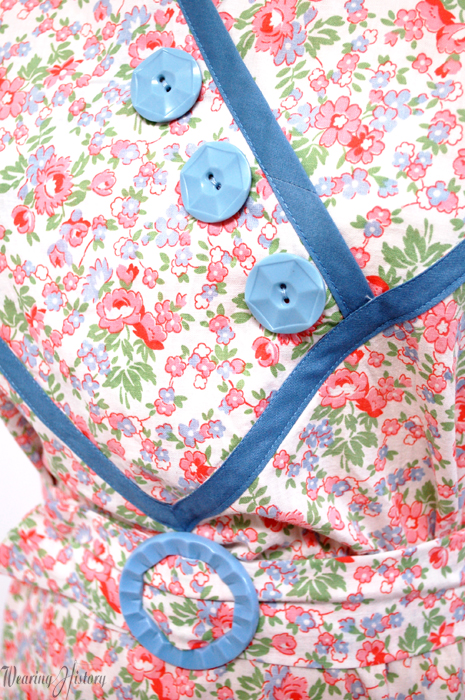
The dress I made is from all vintage materials.  I was fortunate to find a long length of vintage cotton print that I found reminiscent to the feed sack prints the ladies of the dust bowl would have used to make their clothing.  These were actually flour or feed sacks, and a housewife would collect them to make clothing for her family, or sew items for the home.  The buttons, buckle, and the bias tape are all vintage as well.  This is finished on the inside with rayon seam binding.

Very contrary to the dust bowl, today is a very cloudy and rainy day.  I was hoping to take pictures next to some old west style historic buildings, but it was not meant to be!  Since it’s a dark day, it is very hard to capture the colors correctly.

Without the belt, the dress looks rather 1920s.

A closer shot of the detail, which is more true to actual color:

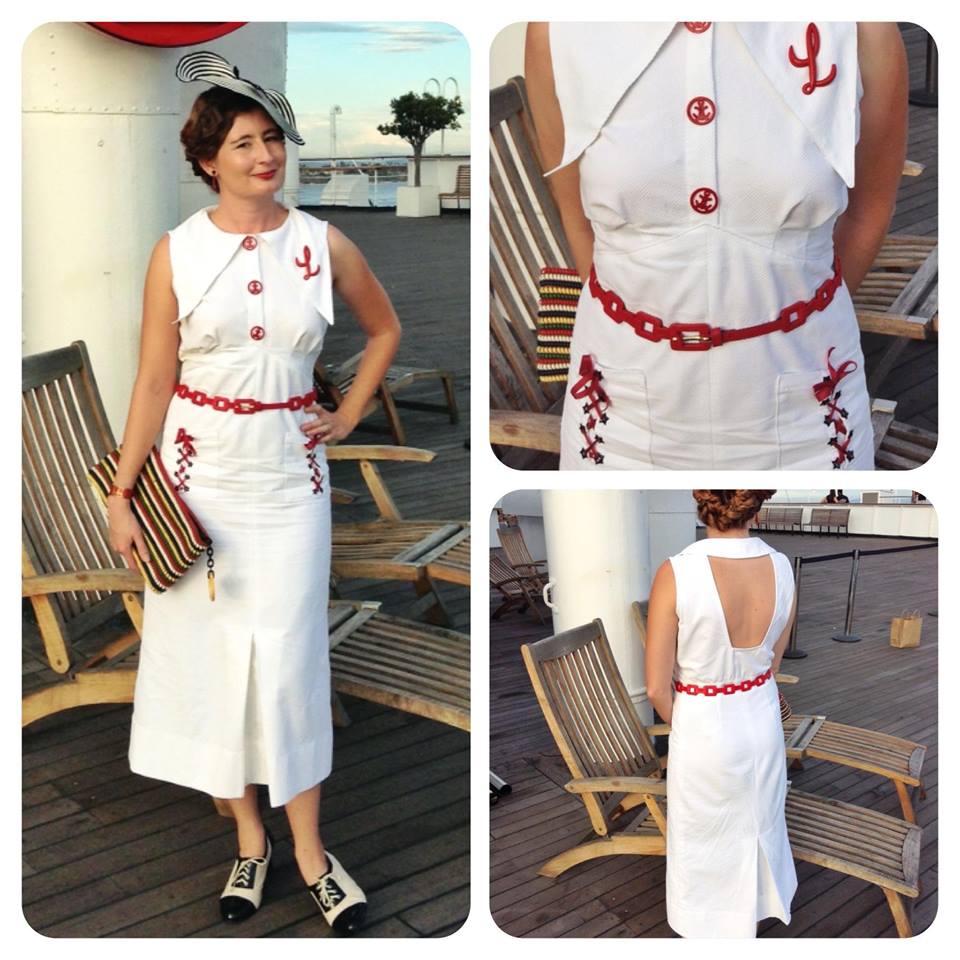
This was made from a  mail order pattern from the earlier part of the 1930s, similar to what farming ladies would have used to make their clothing.  I have a copy, as I sent my original to a friend in England.  Although the dress in the illustration looks rather sporty, I wanted to take inspiration from vintage farm dresses and aprons, so added the bias tape to make this look more like a house dress.

Some inspiration images for this project that were found online:

{Source}

{Source}

{Source}

{Source}

Required info for this challenge

The Challenge: Peasants & Pioneers

Fabric: Vintage cotton print

Pattern: Mail Order 1918

Year: First half of the 1930s (about circa 1932-1934)

Notions: Vintage bias tape, vintage buttons, vintage buckle

How historically accurate is it? Very.  Without finished seams it would be more period, but I wanted to protect from fraying when washing.  The thread is poly, which is not period, but otherwise it’s totally dead on.  I found prints almost identical in a 1934 Sears catalog.

Hours to complete: Around 5-6.

First worn: Not yet!

Total cost: About $25 (not including pattern)

Finished Project: Blue Corset from 1868

I just put the finishing touches on this today, and I’m so glad to finally have it done!  I started the mock up for this sometime last year.  I really wanted a corset I could wear to get a decent silhouette for late 1860s/early 1870s gowns.  I have one Victorian corset I made myself, but it’s more appropriate for the 1880s and didn’t give me much form.  I started reading up about how women who weren’t endowed got their shapes, and talked to other costumers about it.  Jen of Festive Attyre was especially helpful in figuring out what to do.  This corset has sort of revolutionized my thinking about making them, and I’m glad to say that I’m no longer paranoid about making corsets.  It was revolutionary to me to realize that I could make myself fit a corset shape, and fit a corset to fit *me*, when my shape is so not what was the period ideal for the Victorian era.

When I started thinking about this project I knew I wanted a blue corset, like in Edouard Manet’s painting Nana, from 1877.  Although later than this corset by nearly ten years, I have always loved this painting and knew I wanted to mirror this color scheme when I made mine.

The pattern for this corset came from Francis Grimble’s Reconstruction Era Fashions book.  It was reproduced from an original Harper’s Bazar pattern from 1868 and then scaled down by half.  I re-enlarged the pattern and did my mock up. I found in the mock up stage that the original sizing of the corset pattern was several  inches too big for me, so I did some adjustments at the side seams, and some smaller adjustments to the hip and bust gussets, but made sure to leave enough room and not over fit it, so that I had room to pad out to achieve close to a period shape.

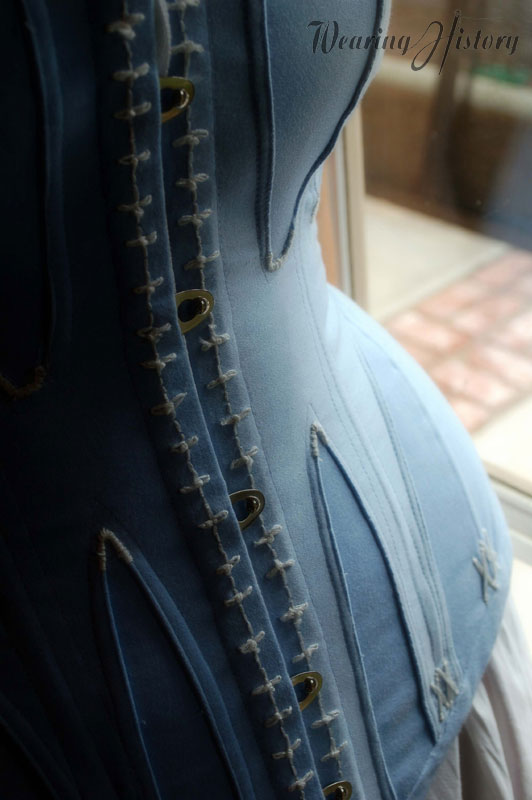
The original pattern called for boning across the back, but I decided I would rather have cording as I thought it would be both more comfortable and more decorative.  My husband was a darling and did the grommets up the back for me.  That’s one thing I really don’t like to do!  The chemise I am wearing is an antique in my collection.  Although I wouldn’t really wear it under clothing for fear of damaging it (although it is quite sturdy), it was fun to wear for pictures.  I need to make one along similar lines someday.

I should also mention that when I went to do my boning channels I realized I missed a tuck that was called for that went from the bottom of the front bust gusset to the bottom of the corset.  Oops?  Since I had already done all my fittings without this tuck I just decided to leave it be, but that accounts for one of the bust gores having a squared off shape at the bottom rather than a point.  Doesn’t bother me, but in case others wanted to try this pattern I thought it should be mentioned.  And as with all period patterns of this age, no seam allowances were included in the original pattern.

The fabric I used was white cotton coutil, to which I flat lined blue cotton sateen.  I was sick for quite a few days last week, so I used the opportunity to do something I don’t usually do- and embroider a little motif up the front of the busk and add some flossing.  I don’t have much skill at this sort of handwork, but it was fun to do and I think it looks kind of pretty!  My initial thought was to do flossing and add a contrast binding and wide lace at the top, but I really like the simplicity of these accents and I’m glad I didn’t go with my first plan.

Just like today, women would pad out what nature didn’t give them naturally.  As I mentioned previously, I was on a quest to get a bit more of a Victorian shape than I had naturally or with my previous corset.  When I took my mock up of this corset to work with me, I had some help from a theatre perspective and found that they still use this trick. One of the “tricks of the trade” are to use men’s tailoring shoulder pads and place them strategically at the sides, both at top of the corset, and at the bottom, to create more of an hourglass shape.  Then you can use little pads in the front for extra support- to create a bit of a shelf.  I tried this, and lo and behold, I actually had a decent shape for the era! Much better than I had had previously.

Since this project was done in conjunction with the Dreamstress’ great group, The Historical Sew Fortnightly, here’s the info required.

The Challenge: Under it All

Fabric: Cotton coutil, cotton sateen

Pattern: Reproduced Harper’s Bazar pattern from Frances Grimble’s Reconstruction Era Fashions Book.

Year: 1868

Notions: Metal spiral and flat steel boning, corset busk, grommets, corset lacing, cotton embroidery floss, stay tape, thread, set of pre-made shoulder pads, cotton quilt batting to make two more pads, white muslin to cover shoulder pads.

How historically accurate is it?  Looks accurate on the outside (embroidery inspired by, rather than reproduced authentically from, period examples), but the inside and construction are done with modern methods.  The gussets were flat lined then serged, and applied with  lapped seams rather than flat felling.

Hours to complete: Several.  From start to finish, perhaps around 10 hours, including several mock ups and time to enlarge and alter the pattern.

First worn:  Not worn yet other than for photos

Total cost: Didn’t keep track but I’m guessing $35-40ish, not including the book cost.

Finished UFO Project, and a Peek at Things to Come…

Did you know that The Dreamstress is hosting a neat Facebook sewing motivation group for this year?  It’s called the Historical Sew Fortnightly, and every two weeks there’s a new challenge.

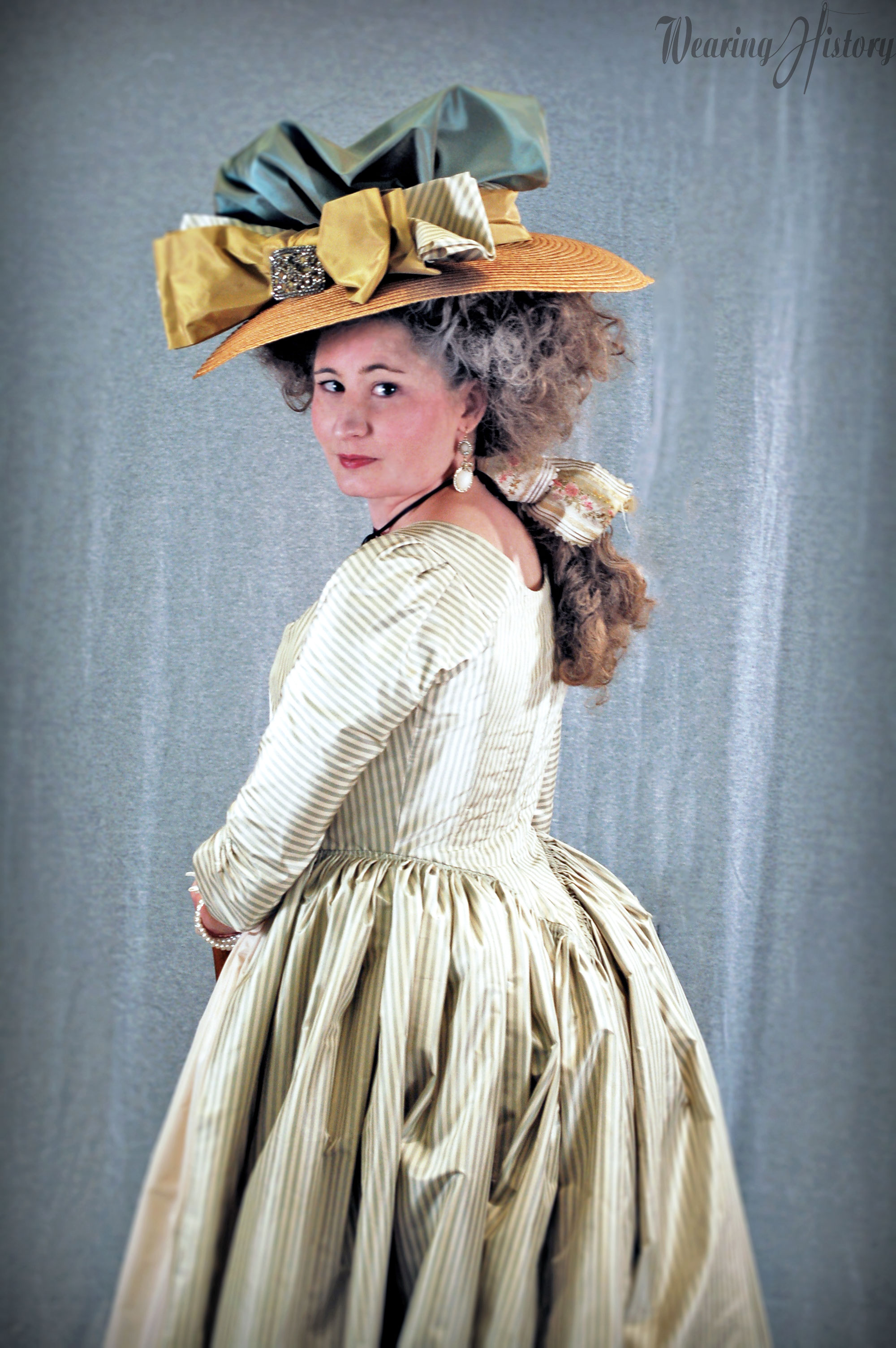
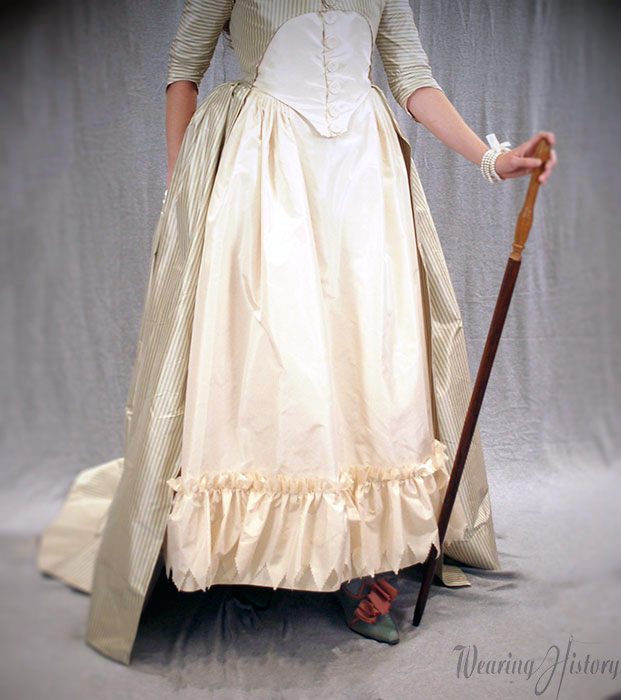
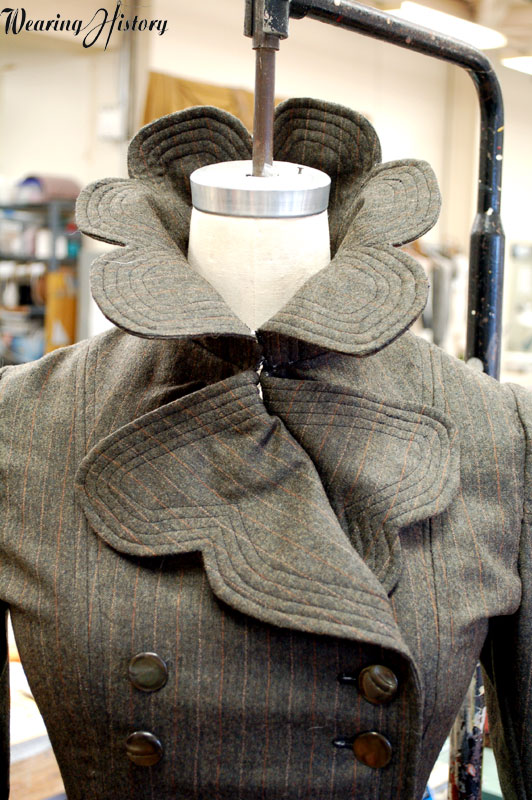
I missed the last challenge, but I got this one finished in time for the UFO theme (unfinished object).  This jacket was based on an 1899 jacket pattern from La Mode Illustree, and I don’t mind saying now, that this is the pattern that I’ve slowly been working on in my free time as the next Wearing History pattern release.  The project was started a year or two ago, with an original pattern, but gradually morphed into a grande project, as I kept finding more and more that I needed to do to make the pattern more accessible and understandable (markings, seam allowances, grainlines, and instructions were all missing, and the pattern pieces needed alterations to get them to fit together correctly).  I’ll have more info on it once it’s completely finished and I have the pattern up on my site, but for now I’m just glad to share preview pics I took at work today :) I went all out on this jacket and did a bunch of tailoring on it to make it extra nice.